
7-minute read
Introductory Note from the Team Chief: Due to the length of CATR #35, we decided to break this post, which was nearly the same size, into two parts. Part 9a focused primarily on the protection of civilians; part 9b focuses primarily on the protection of civilian objects while maneuver forces execute missions throughout the AOR.
COL(R) DJC
________
Protection of Civilian Objects – The First Monuments Man.
Civil affairs Soldiers assigned to the Monuments, Fine Arts, and Archives (MFAA) sections, also known as the Monuments Men, were part of one of the first organized military efforts to systematically protect cultural heritage during war. Like their tactical CA counterparts, MFAA activities began slowly, with few personnel assigned to the mission early on and their role not clearly defined for maneuver commanders.
Based on my research so far, including the book The Monuments Men: Allied Heroes, Nazi Thieves, and the Greatest Treasure Hunt in History by Robert M. Edsel and Bret Witter (Monuments Men), the first “Monuments Man” was Captain Mason Hammond, a Harvard classics professor who served in Army Air Forces Intelligence. He was called upon to participate in a new conservation program, designed in collaboration by American and British museum directors concerned about the potential for wartime destruction of cultural sites and artifacts beyond the already documented incidents in North Africa.
Hammond arrived in Algiers, Algeria, in June 1943 with no knowledge of the mission he had been assigned to. Expecting to work on conservation issues in North Africa, he soon learned he would be joining the invasion of Sicily (described in CATR #32) to inspect all monuments in the occupied territories as combat operations transitioned to occupation. He was given neither the time nor the resources to research Sicily’s history and historical sites, and a list of protected sites being prepared in New York would not be available until after combat forces landed on the island.
Because he was considered part of the occupation force, Hammond did not arrive in Sicily until three weeks after the Allied beach landings. He learned about the island’s monuments through “guided tours” led by local cultural officials. He found that the Sicilian capital, Palermo, was in the greatest need of MFAA support, but as the sole MFAA officer in the Allied Military Government in Occupied Territories (AMGOT), he could do little without equipment, supplies, funding, or guidance until the occupation matured (Monuments Men, pp. 38-40).
Getting Serious about Protecting Civilian Objects.
Earlier, we noted that the 1943 version of FM 27-5 described public order as the means to protect civilians and civilian objects during war and that this protection was achieved primarily through the administration of CA and MG. It did not provide substantive guidance on targeting decisions or on restrictions on the use of specific munitions. For those issues, the manual generally referred to international law and other military legal references, such as FM 27-10.
An AI-assisted review of the 1940 version of FM 27-10 shows that it recognized limits on targeting through the principles of military necessity and humanity. It also explicitly restricted certain categories of weapons under the Hague treaties, including poisoned weapons, weapons intended to cause unnecessary suffering, and certain balloon-delivered explosives. However, it lacked the detailed targeting restrictions found in modern treaties, laws, and doctrine.
One incident that changed that was the destruction of the 1,400-year-old Benedictine Abbey in Monte Cassino, Italy, on 15 February 1944, when American and Allied bombers dropped 1,400 tons of high explosives on the historic hilltop monastery. At the start of the war, it was known that the important cultural and religious landmark was not being used for military purposes. However, in 1944, Allied forces came to believe, based on intelligence later determined to be incorrect, that German troops were occupying the monastery. As a result, Allied bombing operations targeted the abbey, reducing the historic structure to rubble and completely destroying it. The attack also caused heavy civilian casualties, killing hundreds of civilians who had taken shelter inside the monastery. (Multiple sources.)
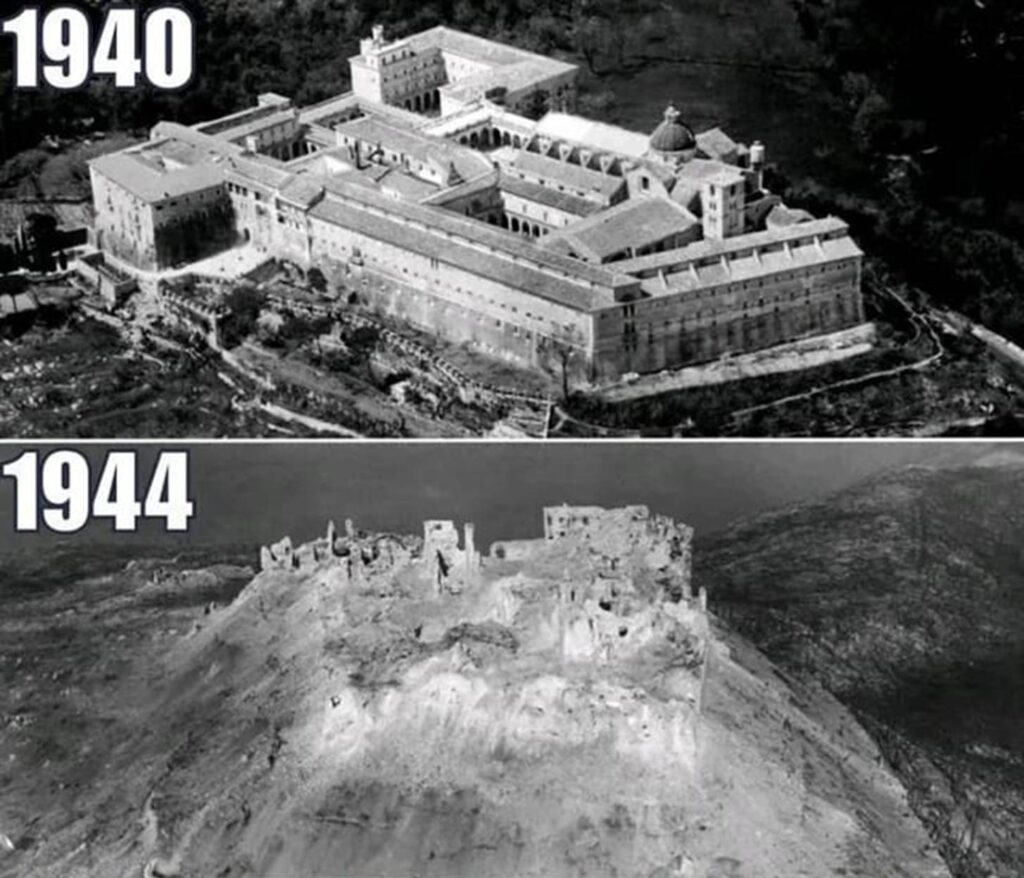
The Benedictine Abbey in Monte Cassino, Italy, before and after its destruction on 15 February 1944.
The destruction of Monte Cassino Abbey became a widely recognized example of the failure to adequately protect cultural heritage during armed conflict and later helped inspire international agreements, including the 1954 Hague Convention, and the creation of symbols such as the Blue Shield, aimed at safeguarding cultural property in war.
In the immediate aftermath, however, Gen. Dwight D. Eisenhower directed the implementation of corrective measures through official correspondence to the Allied forces he commanded. Two examples of Gen. Eisenhower’s letters to commanders are provided below. The third paragraph of the first letter states,
“It is a responsibility of higher commanders to determine through A.M.G. [Allied Military Government, i.e., Monuments, Fine Arts, and Archives] Officers the locations of historical monuments whether they be immediately ahead of our front lines or in areas occupied by us. This information passed to lower echelons through normal channels places the responsibility on all Commanders of complying with the spirit of this letter” (bold font added for emphasis).


Five months later, by the end of May 1944, most of the planning for D-Day had been completed. However, on 26 May 1944, just a few days before the scheduled landings, Eisenhower issued a similarly worded instruction to protect the “historical monuments and cultural centers” that will inevitably be found “in the path of our advance.” Paragraph 4 states,
“[…] there are many circumstances in which damage and destruction are not necessary and cannot be justified. In such cases, through the exercise of restraint and discipline, commanders will preserve centers and objects of historical and cultural significance. Civil Affairs Staffs at higher echelons will advise commanders of the locations of historical monuments of this type, both in advance of the front lines and in occupied areas. This information, together with the necessary instructions, will be passed down through command channels to all echelons.” (bold font added for emphasis).
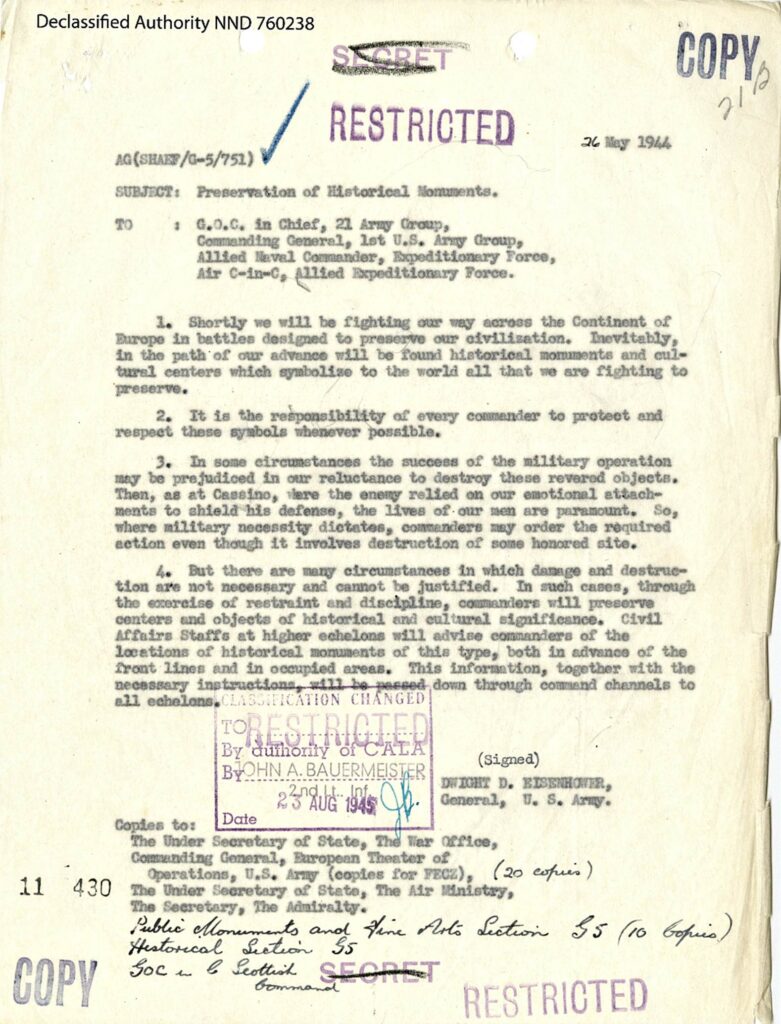

Thus, at the direction of the Supreme Allied Commander, CA and MG forces – particularly the archeologists, museum curators, art historians, librarians, archivists, and related specialists assigned to the MFAA sections – with their extensive networks in the U.S., UK, and around the world, were placed at the center of efforts to protect, preserve, and recover cultural properties and items across Europe and the Pacific for the remainder of the war.
As the war progressed, the identification and proactive protection of cultural property became increasingly systematic. The MFAA program established an integrated cultural-property protection framework comprising inventories, maps, atlases, classification systems, repository surveys, inspection procedures, damage-assessment programs, reporting channels, advisory mechanisms, liaison networks, off-limits controls, anti-looting measures, and cultural-property tracking systems. Together, these products and procedures enabled Allied commanders to identify, protect, monitor, and recover cultural sites and objects throughout World War II.
I’ll close this topic with a story from the Battle of the Bulge that illustrates several of the elements in bold above. It shows that commanders took the protection of cultural sites and objects seriously, even during combat, and that conducting this task can be far from safe. It’s from the discussion of CA/MG in a defense operation in Case Studies on Field Operations of Military Government Units, which we have referenced several times before.
“CA/MG was instrumental in protecting hisotrical (sic) monuments, art objects, and archives at Remouchamps, Stavelot, Trois Ponts, and Waimes.
At Ambleve, Belgium, CA/MG personnel gave their lives fulfilling this duty. It was in this town that a depository of sculpture, paintings and furniture from Aachen had been inventoried and turned over to the Burgomeister for safekeeping. Six members of the V Corps Provisional Military Government Security Guards were placed as guards on the depository.
The V Corps Report of December 19–20 [1944] states:
‘Hq. V Corps MG Police Battalion reports that six of their men who were guarding the archives at Ambleve, now in enemy hands, and two others who attempted to evacuate the guards are missing in action. An informal report from a soldier stationed in the vicinity who escaped indicates that several of these were killed.’
Despite efforts of CA/MG to protect the art treasures, at least one incident occurred in which American troops perpetrated ‘rather serious damage to valuable property which cannot now be replaced.’ This resulted, according to ACOS, G-5, XVIII Corps (Airborne), [from] lack of information on the existence of such property. As a result of this incident, arrangements were made with First U.S. Army G-5 for getting proper prior information.’” (Case Studies, p. 137)
Questions for our teammates: Were you aware of the history of CA and MG units’ involvement in the protection of civilians and civilian objects during WWII or how that involvement led to processes we use today? Have you used any of these processes to protect civilian objects in operations you participated in? Do these vignettes provide better context for how we might protect civilian objects in future LSCO?
Send a note to the Civil Affairs Team Room.
Responses from Teammates:
2-minute read
7 Sep 2026, Lt. Col. (Ret.) Albert Augustine: Any real-world examples from Iraq, Afghanistan, or Ukraine? I am a huge fan of history and the movie; however, I get the sense nobody cares about that aspect outside of CA?
12 Sep 2026, Col. (Ret.) Dennis J. Cahill, in response to above: Hi Teammate: Thanks for your question.
Since April, I have been writing about the role of CA in LSCO using only examples from the largest LSCO in which U.S. forces participated in the last century – World War II.
The real birth of modern CA forces occurred after December 7th, 1941. Since CA forces had never been used in combat before, much of what we know about employing CA in offense, defense, and stability comes from expensive experiential learning in the European and Pacific Theaters from 1942 to 1945. Civil affairs and military government forces had to innovate, disseminate lessons, and transform quickly during those three years to become the force multiplier they were by the end of the war.
As I said in the opening sentence of CATR #37, “Civil affairs Soldiers assigned to the Monuments, Fine Arts, and Archives (MFAA) sections, also known as the Monuments Men, were part of one of the first organized military efforts to systematically protect cultural heritage during war.” From my research, they were the first to develop the tactics, techniques, and procedures (TTPs) for protecting, assessing, and recovering cultural sites and artifacts that were used in Iraq and Afghanistan and are still used today in places like Ukraine.
If I understood you correctly, you say that you “get the sense nobody cares about [protecting cultural sites and artifacts] outside of CA” and would like to see “real world examples from Iraq, Afghanistan, or Ukraine.” I think that is an excellent topic for a future CATR post, and I invite you and anyone else with interest or knowledge of successes and failures to protect, assess, or recover cultural sites and artifacts in those or any other more recent combat actions to send a note to the Civil Affairs Team Room at https://www.civilaffairs-teamroom.com/contact-us/. Let’s develop a new post and keep the conversation going.
Subscribe for updates to the Civil Affairs Team Room Blog
Don’t forget to check out our affiliated sites
Quiet Signal (formerly LC38 Brand) – Use code CATR2026 at checkout
Aerial Resupply Coffee – Use code CATR2026 at checkout
One response to “CATR Post #37 – What is the role of Civil Affairs in large-scale combat operations? (Part 9b – Protection of Civilians and Civilian Objects)”
[…] stories of CA and MG operations in WWII underscored this need. As we saw with the Monuments Men in CATR #37, uniformed CA and MG professionals were valuable not only for their personal knowledge, skills, and […]