
20-minute read
Our posts so far have focused primarily on civil affairs (CA) and military government (MG) operations in the North African Campaign and the European Theater of Operations (ETO) during World War II (WWII). In this post, we turn to the Pacific Theater of Operations (PTO) and examine CA and MG operations in the Philippines and on the Ryukyu Islands, particularly Okinawa, where the last major battle of WWII and the bloodiest campaign in the Pacific were fought.
Philippines.
According to History.com’s This Day in History, referring to 11 March 1942:
“After struggling against great odds to save the Philippines from Japanese conquest, U.S. General Douglas MacArthur abandons the island fortress of Corregidor under orders from President Franklin Roosevelt. Left behind at Corregidor and on the Bataan Peninsula were 90,000 American and Filipino troops, who, lacking food, supplies and support, would soon succumb to the Japanese offensive […] Deeply disappointed, he issued a statement to the press in which he promised his men and the people of the Philippines, ‘I shall return.’”
When U.S. forces returned to the Southwest Pacific Area (SWPA) under General MacArthur later in the war, the Philippines, like France, was an ally in need of liberation from a hostile enemy force. U.S. Army forces heading there included uniquely tailored formations known as Philippine Civil Affairs Units (PCAUs). Each of the 30 PCAUs, numbered PCAU 1 through PCAU 30, comprised a hastily trained mix of U.S. and Filipino Soldiers, including a specialized medical officer and four medical assistants.
MacArthur returned to the Philippines on 20 October 1944 with two objectives: to defeat and expel Japanese forces and to restore the Philippine Commonwealth Government, which had gone into exile after the 1942 Japanese conquest (Case Studies, p. 210). The Philippines campaign consisted of a series of major operations and battles across the archipelago, officially ending on 15 August 1945.
Below, we examine the role of CA and MG detachments in two major battles of the campaign.
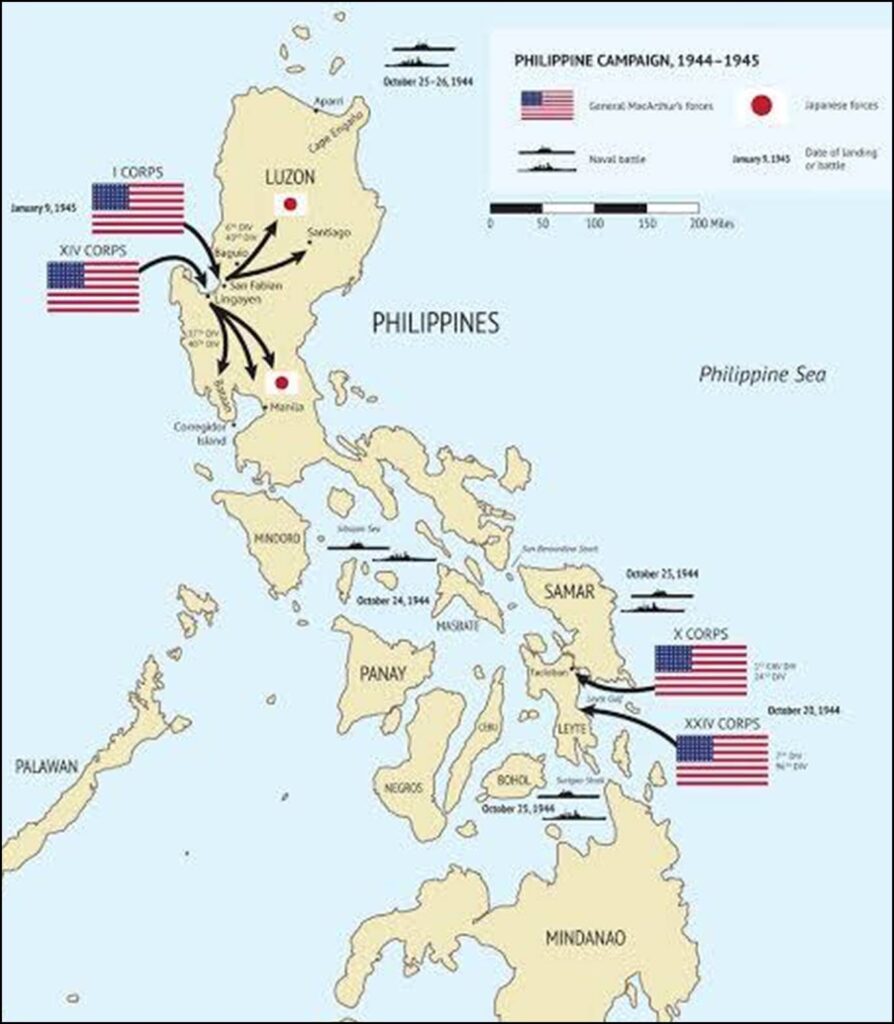
Leyte (20 October – December 1944). Drawing on multiple sources on 30 May 2026, my research assistant, Copilot, found that U.S. Army operations on Leyte began on 20 October 1944, when Sixth Army – led by X Corps and XXIV Corps – launched an amphibious assault at Tacloban, Palo, and Dulag, establishing beachheads under heavy Japanese resistance. Through November, U.S. forces fought a series of intense engagements across the island, including the drive through the Leyte Valley, the seizure of key mountain passes, and major battles around Ormoc as reinforcements from the 7th, 24th, 77th, and 96th Infantry Divisions pushed westward. By late December 1944, coordinated ground, naval, and air operations had destroyed organized Japanese resistance, securing Leyte and enabling follow‑on operations toward Luzon.
The Battle of Leyte subjected the civilian population to extreme hardship as fighting, bombardment, and Japanese defensive actions displaced tens of thousands of people from towns like those mentioned above. Many civilians fled to beaches, roadsides, or mountainous areas, where they faced shortages of food, shelter, and medical care. Large concentrations of these dislocated persons (DPs) – sometimes 10,000 to 45,000 at a time – created urgent humanitarian crises. As U.S. forces advanced and Japanese resistance collapsed, civilians gradually returned to their towns, but widespread destruction of homes, public buildings, utilities, and markets meant that recovery required extensive relief, public health measures, and the rapid reestablishment of local governance.
Civil Affairs Operations on Leyte.
The PCAUs that supported the Battle of Leyte were rapidly organized, minimally trained teams created to accompany the assault forces and immediately assume responsibility for civilian administration in newly liberated areas. Activated on 16 September 1944 at Oro Bay, New Guinea, PCAUs 1-8 consisted of 10 to 11 officers and 39 enlisted men. Officers were selected for their civilian expertise, and enlisted personnel were drawn from Filipino units. Despite only five days of training, they were fully equipped, attached to the Sixth Army on 3 October, and arrived on Leyte between 20 and 23 October 1944, landing at Tacloban, Palo, and Dulag almost simultaneously with the maneuver units they supported.
Operating under active fire – including naval bombardment, air raids, and sniper activity – they immediately established dispensaries and ration points, provided medical care to local citizens during attacks, supplied civilian labor to combat units, and began reestablishing municipal governance. As U.S. forces advanced inland, PCAUs expanded their responsibilities in newly established rear areas to include reopening schools, restoring public health systems, enforcing public safety ordinances, repairing essential infrastructure, organizing labor forces, and distributing relief supplies to numerous municipalities within the area of operations.
These CA activities had a direct, measurable impact on the effectiveness of U.S. maneuver and maneuver‑support forces during the Leyte campaign. PCAUs removed tens of thousands of civilians from active combat zones – PCAU 7 alone evacuated 10,000-30,000 people around Ormoc – thereby clearing routes, reducing congestion, and preventing interference with troop movements, logistics, and fires. They provided critical labor support, including 200 laborers to carry ammunition and bear stretchers during the Ormoc push, as well as additional workers to repair roads, clear towns, and construct cemeteries.
Public health operations, such as mass vaccinations and the establishment of the first functioning laboratory on Leyte, prevented disease outbreaks that could have spread to combat forces or forced the diversion of combat units to humanitarian tasks. By supervising police forces, enforcing ordinances, and restoring courts, PCAUs maintained order in rear areas, protecting supply lines and preventing looting and unrest. Their efforts allowed U.S. divisions and corps to remain focused on combat operations, avoiding the diversion of entire battalions to civil‑control duties and directly contributing to the operational tempo and success of the Leyte campaign.
Luzon (9 January 1945 – July 1945). Copilot also noted that U.S. Army operations during the Luzon campaign began with the Sixth Army conducting the largest amphibious operation of the war in the Pacific to date at Lingayen Gulf. The 6th, 37th, 40th, and 43rd Infantry Divisions established beachheads and advanced rapidly inland against scattered but determined Japanese resistance. Through the spring of 1945, U.S. forces – including I Corps and XIV Corps – fought major engagements to seize Manila, clear the Bataan Peninsula and Corregidor, and destroy Japanese strongholds in the Sierra Madre and Cordillera mountain ranges. By 30 June/1 July 1945, coordinated operations across northern and southern Luzon had eliminated organized Japanese resistance, securing the island and enabling the final U.S. offensives across the Philippines.
The Battle of Luzon inflicted enormous suffering on the civilian population, particularly in and around Manila, where intense urban combat, artillery bombardment, and widespread atrocities by retreating Japanese forces killed more than 100,000 noncombatants. Across the island, civilians endured mass displacement, food shortages, the destruction of homes and public infrastructure, and the collapse of essential services as fighting spread from Lingayen Gulf through central Luzon and into the mountainous interior. By the time organized Japanese resistance ended, much of Luzon’s urban and rural landscape had been devastated, leaving millions of Filipinos dependent on emergency relief, medical care, and the reconstruction of local governance and essential services.
Civil Affairs Operations on Luzon.
The CA presence on Luzon centered on PCAU 8, which entered Luzon shortly after major combat in Manila and immediately began operations in the devastated capital. It treated 886 patients daily, fed 29,093 indigent civilians, reopened schools, restored hospitals and sanitation systems, distributed essential supplies, and recruited labor for military and civilian needs. As the campaign progressed, PCAU 8 expanded into the Bicol Region, where it appointed provincial and municipal officials, reopened 1,055 schools, restored water and power systems, rebuilt transportation networks, reestablished markets and police forces, conducted public health campaigns, and employed 2,899 laborers daily. It also intervened to remove unauthorized guerrilla leaders who had seized political control.
These activities provided substantial value to maneuver and maneuver‑support forces operating on Luzon. By treating thousands of civilians and distributing relief supplies, PCAU 8 prevented Army medical facilities from being overwhelmed and reduced the risk of unrest that could disrupt supply lines. Restored infrastructure – roads, bridges, water systems, and power plants – directly supported troop movement, logistics, headquarters operations, and communications. Reconstituted police forces and courts stabilized the security environment, reducing crime, looting, and guerrilla‑related interference with military operations. The large labor force organized by PCAU 8 supported engineers, hospitals, depots, and transportation units, freeing U.S. soldiers for combat tasks. Finally, by reestablishing governance and essential services across Manila and the Bicol provinces, PCAU 8 enabled maneuver units to redeploy to other parts of Luzon or other islands, ensuring that combat power remained focused on defeating Japanese forces rather than being diverted to civil‑control duties.
Japan.
Ryukyu Islands (26 March 1945 – 2 July 1945). The Ryukyu Islands once formed an independent country, the Ryukyu Kingdom. It existed for centuries and traded widely with China, Japan, and Southeast Asia. In 1879, Japan officially incorporated the islands into its territory, so that in 1945, even though the islands had distinct cultures, languages, and traditions that differed from those of mainland Japan, they were considered part of the Japanese homeland. Okinawa was the largest, most populous, and economically dominant island in the entire 700-mile-long Ryukyu archipelago. Approximately two-thirds of the roughly 500,000 residents of Okinawa at the time lived on the southern one-third of the island, which contained Okinawa’s two largest urban centers, Naha and Shuri.
Japanese defense forces in the Ryukyus were largely consolidated on Okinawa. They consisted of “over 77,000 Imperial troops […] about 20,000 Okinawa Home Guards (Boeitai), and even 750 male Okinawan middle-school students who were organized into ‘Blood and Iron for the Emperor’ (Tekketsu) volunteer units and trained for combat, as well as thousands of other Okinawans conscripted as civilians for labor and other service duties.” U.S. military planners expected them to mount a strong defense of the beaches against invaders.
Okinawa (1 April – 22 June 1945). According to several online sources, the Tenth Army headquarters was established at Fort Sam Houston, Texas, on 20 June 1944 and later relocated to Pearl Harbor, Hawaii, to lead the planned invasion of Formosa (now Taiwan). After U.S. leaders decided in July 1944 to invade the Philippines instead of Formosa, the Tenth Army was tasked with capturing the Ryukyu Islands to secure bases from which Allied forces could strike the Japanese home islands, sever Japan from its southern empire, and prepare for a final invasion of Japan. Planning for Operation Iceberg began immediately.
To execute the joint U.S. Army-Navy amphibious campaign, Lieutenant General (Lieut. Gen.) Simon Bolivar Buckner, Jr., commander of Tenth Army, was given the U.S. Army’s XXIV Corps (which had previously operated in Leyte), consisting of the 7th, 27th, 77th, and 96th Divisions, and the U.S. Marine Corps’ III Amphibious Corps, consisting of the 1st, 2nd, and 6th Marine Divisions. He also commanded a Tactical Air Force under a Marine major general.
In late March 1945, the Tenth Army seized several islands and atolls west of Okinawa to serve as a naval anchorage, supply base, and forward support base. On 1 April, both the XXIV Corps and III Amphibious Corps launched the largest amphibious assault of the Pacific War on the Hagushi beaches of Okinawa. Contrary to expectations, these forces were virtually unopposed. Rather than contesting the beach landings, Japanese commanders placed some detachments in sparsely populated central and northern Okinawa and concentrated their defenses in depth in southern Okinawa, in heavily fortified defensive lines anchored on ridges, caves, reverse slopes, and the urban areas of Naha and Shuri.
On 3 April, Lieut. Gen. Buckner sent the III Amphibious Corps toward its objectives in the northern part of the island. The Marines quickly encircled and neutralized pockets of enemy resistance, and by 20 April, “[f]ormal resistance […] ceased,” freeing the Marines to reinforce Army units in the south. However, as we’ll see below, “[t]here were organized guerrilla activities conducted by the remnants of Japanese army and naval forces in the mountainous northern two-thirds of this island after that part of the island had been declared secure” (Case Studies, p. 180).
In the south, after weeks of heavy fighting, U.S. forces captured Shuri in late May and seized the Naha area, including its airfields, in early June. The Japanese commander, Mitsuru Ushijima, and other senior leaders committed suicide as U.S. forces overran the final positions on 21–22 June 1945. As organized resistance ended, thousands of disoriented civilians emerged from their cave shelters. U.S. forces then transitioned from active combat to preparing Okinawa as a forward base, supporting occupation functions, and laying the groundwork for a potential invasion of Japan.
Okinawa was the last major battle of World War II and the bloodiest amphibious campaign of the Pacific War, inflicting heavy losses on all participants. American forces suffered more than 75,000 casualties, including 12,520 killed or missing, and lost hundreds of aircraft and ships; among the dead were war correspondent Ernie Pyle and Tenth Army commander Lieut. Gen. Buckner. Japanese forces lost approximately 120,000 troops. Civilian losses and destruction were concentrated in southern Okinawa, where most of the population lived, and the heaviest fighting occurred around Naha and Shuri. Estimates of civilian deaths range from tens of thousands to over 100,000, and bombardment and ground combat left much of the island’s infrastructure – especially in Naha – severely damaged or destroyed.
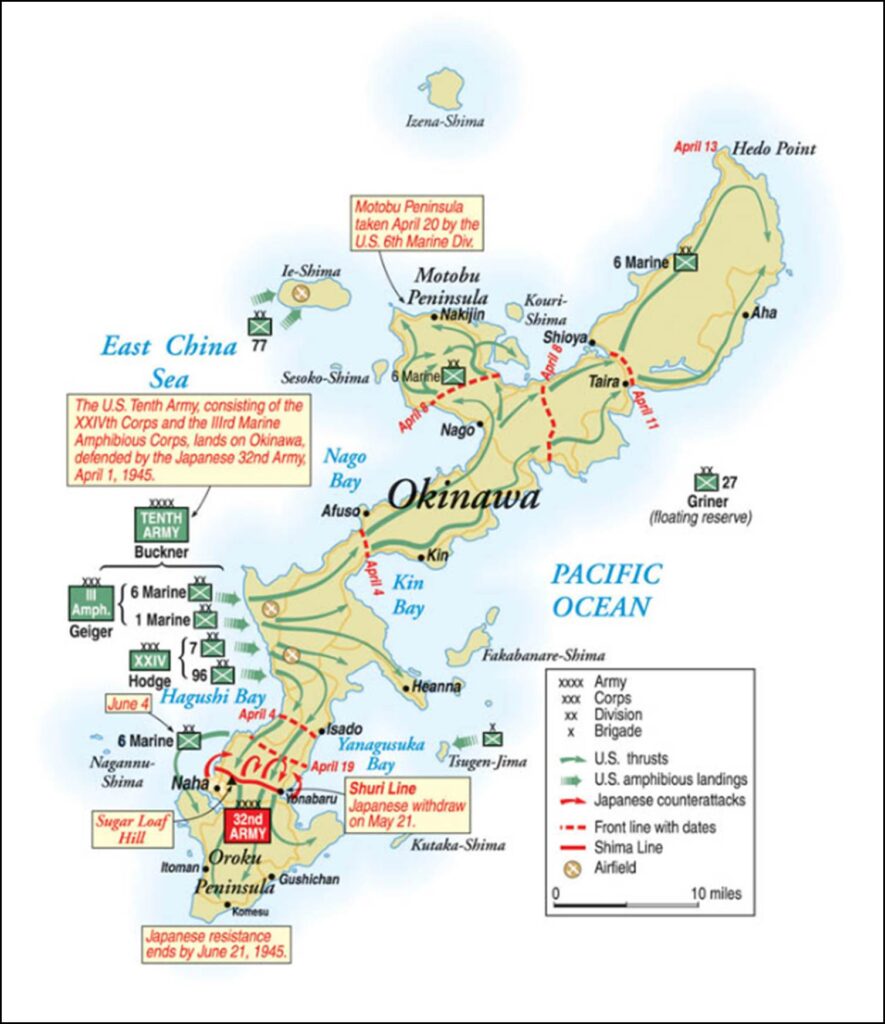
[Source: Steel Typhoon at Okinawa, https://warfarehistorynetwork.com/article/steep-typhoon-at-okinawa/?lp_fresh_register=1]
Military Government Operations on Okinawa.
As part of Japan’s homeland, Okinawa would be considered occupied territory after its seizure.
“This was the only operation of the war against a Japanese land area of appreciable size that involved a large civilian population. It is, therefore, the only case of American Military Government combat operation involving an Oriental population” (Case Studies, p. 180).
MG planning began in August 1944 as part of Operation Iceberg planning and was integrated into the overall campaign plan from the outset. The Tenth Army MG planners undoubtedly drew lessons from amphibious assaults and offensive operations conducted up to that point in the European campaign.
According to Operational Directive Number 7 for Military Government of the Commanding General Tenth Army, short title “GOPER,” dated 6 January 1945,
“The object of Military Government is to assist military operations, to further national policies, and to fulfill the obligation of the occupying forces under international law.· This assistance is rendered by maintaining order, promoting security of the occupying forces, preventing interference with military operations, reducing active and passive sabotage, relieving combat troops of local civil administration and mobilizing local resources in the aid of military objectives” (Case Studies, p. 186; bold font added for emphasis).
Toward that end, Tenth Army organized MG detachments by echelon as follows:
- “Military Government ‘A’ Detachments: The ‘A’ detachments attached to divisions will remain under divisional control until completion of the operation. ‘A’ detachments conduct military government reconnaissance, and assist in the following civilian functions: control; establishing civilian collection points separate from but adjacent to prisoner of war collection points; posting proclamations and issuing civilian relief supplies available to the division. In addition they may act as military government staffs for the division commanders. At the direction of the Expeditionary Troop Commander they may be transferred to the control of the Island Commander.” (Roughly equivalent to CA teams and CA companies supporting maneuver brigades and battalions, respectively, today.)
- “Military Government ‘B’ Detachments: These detachments are attached to corps and divisions and perform duties within the areas of units to which assigned. When the ‘A’ detachments are required to advance, ‘B’ detachments will continue the emergency military government work begun by the ‘A’ detachments. ‘B’ detachments will normally remain in the area to which initially assigned and at the discretion of the next senior commander may be relieved from units to which assigned and used for military government duties in the areas uncovered by the advance.” (Roughly equivalent to CA battalions and CA brigades supporting divisions and corps, respectively, today.)
- “Military Government ‘C’ Detachments: The principal mission of the ‘C’ detachment is that of establishing and operating civilian camps. These detachments will land under corps and Army control and are capable of providing initially a camp for 2500 people, which later may be expanded to a capacity of 10,000.” (Roughly equivalent to the CA battalion or CA brigade government function specialists today.)
- “Military Government ‘D’ Detachments: These detachments will be landed at the target during the late assault phase or the early garrison phase, and will take over the military government duties at the district level, absorbing the ‘B’ teams and exercising control over the ‘C’ teams within their districts. A ‘D’ team after absorbing ‘B’ teams is capable of administering a civilian population of between 60,000 to 100,000 people, and in addition can supervise any civilian camps located within the district.” (Roughly equivalent to CA command government function specialists today.) (Case Studies, pp. 188-189; bold font added for emphasis.)
Tenth Army also dedicated “Navy Medical and CB, and Army MP and quartermaster truck units […] to work in conjunction with the detachments listed above. Normally they will not be used for other than military government assignments” (Case Studies, p. 189; bold font added for emphasis).
Unlike the amphibious operations we saw in the ETO, MG detachments would accompany each echelon as it landed on the beaches of Okinawa. Maneuver commanders integrated MG into their schemes of maneuver, treating it as an inherent command responsibility and exercising operational control over the MG units assigned or attached to them. This ensured that MG operations could begin immediately after units secured terrain.
“Six (6) A teams, consisting of four (4) officers and eleven (11) enlisted men, were organized to accompany assault divisions and to conduct preliminary reconnaissance as the troops advanced. Eight (8) B Teams, each of (8) eight officers and nineteen (19) enlisted men, were attached to both Corps and Divisions; their mission was to organize Military Government activities behind the fighting front as civilians were uncovered. Thirteen (13) C Teams, of ten (10) officers and twenty-six (26) enlisted men each, were organized to administer the refugee civilian camps contemplated. Six (6) D Teams, each consisting of twenty-two (22) officers and sixty (60) enlisted men, were activated to administer the six (6) Military Government Districts into which it was contemplated the Island of Okinawa would be divided” (Case Studies, p. 201; bold font added for emphasis).
At one point during the operation, “an apparent conflict in command responsibility arose when both an A and a B Detachment were attached to a tactical unit. This problem was solved in the III Amphibious Corps by combining the A and B Detachments [into a Military Government Assault Company] and placing them under the command of the Senior MG Officer present” (Case Studies, p. 206). A report on Military Government Operations in the Ryukyus Area, covering August 1944 to June 1945, recommended:
“That the Military Government Assault Company be adopted as the standard Military Government assault unit for this Army. This unit is designed to be attached to assault divisions and Corps and is sufficiently flexible to operate either in an area similar to the RYUKYUS where the principal problem was one of rapid evacuation of civilians to rear areas or in a more densely populated area where the principal problem may be the maintaining of orderly civilian communities within the combat area. This unit will be capable of more efficiently performing the tasks assigned to both A and B Detachments in this operation because it has the advantages of unified command, additional interpreters, maintenance personnel and riflemen, and is a self-sufficient unit. In addition, this unit has been designed so that it can perform the function of a “C” Camp Detachment for limited periods […] One Military Government Assault Company should be attached to each division, to remain attached to the same division during the entire assault phase of an operation. Additional MG Assault Companies may be attached to Corps and Army when required by the expected numbers of the civilian population and the type of civilian control to be adopted” (Case Studies, p. 208; bold font added for emphasis).
MG Challenges in the North.
Once the northern portion of the island was declared “secure” and III Amphibious Corps redeployed to the south to reinforce XXIV Corps, the MG units left behind to administer the military government were
“harassed by guerrilla activities and organized resistance to their control of the civilian population […] [R]emnants of Japanese army and naval forces in the mountainous northern two-thirds of this island […] retained and used the former police force to organize and control a large percentage of the civilian population living in caves and temporary shacks in the mountains. The activities of these guerrilla bands consisted of unexpected harassing night attacks carried out by machine gun, rifle, and mortar fire against the headquarters and bivouacs of small units, during which many military government personnel were wounded, and a number were killed. Other activities consisted of ambushing and slaying the occupants of single vehicles on the roads during the day and in ambushing the unwary soldier who strayed too far on foot from the protection of a military installation. These bands also fought against the control of the civilians by the American Military Government using all means and methods, including propaganda, threats, punishment, and the kidnapping, trial, and execution by beheading or torture of civilian leaders who were collaborating with military government…They became especially active in rear areas from which all tactical units were withdrawn and where military government units were practically the only American installations in large areas. The military government teams learned very early to set up airtight local defenses of their headquarters and bivouax (sic) areas throughout the hours of darkness and procured the necessary automatic weapons, grenades, trip-flares, etc. for their own defense […] [T]his experience offers an example of military government personnel having to fight for their own survival and at the same time conduct military government activities in competition with a planned and organized enemy guerrilla resistance movement” (Case Studies, pp. 180-181; bold font added for emphasis).”
MG Challenges in the South.
In southern Okinawa, MG operations began immediately upon first contact with displaced civilians and adapted to the tempo of combat. As combat forces encountered civilians in the operational area, MG units quickly brought them under control, removing them from tactical areas and concentrating them in safer, controlled locations. Approximately 125,000 civilians were processed and evacuated under fire by forward detachments during the first month of the operation. Rear-area organizations constructed and administered extensive camp systems that provided food, sanitation, medical care, and organized labor, often using salvaged supplies from civilian and captured enemy sources.
As the campaign progressed, district-level elements coordinated activities across multiple camps and imposed broader administrative measures. In June 1945, as organized Japanese resistance collapsed and civilian populations surged into Allied-controlled zones, MG units intensified and consolidated their efforts, replacing improvised measures with more systematic administration for a rapidly expanding population. MG personnel remained closely integrated with tactical commands, carefully managed civilian interactions through interpreters, and supervised local officials. By late June, these evolving structures marked a clear transition from immediate combat support to stable district governance, laying the groundwork for occupation administration under the Tenth Army’s Island Command authority.
MG Contributions to the Military Effort.
MG units contributed directly to military effectiveness throughout the campaign. They consolidated and screened civilians, helping distinguish noncombatants from potential enemy personnel and enhancing security and intelligence for U.S. forces. They organized large-scale salvage and redistribution of resources, including food stocks, vehicles, tools, and construction materials for military use. They coordinated civilian labor for crop harvesting, infrastructure repair, and recovery of usable materials, thereby augmenting military logistics and sustainment. These and other MG activities improved operational efficiency and stability in rear areas and achieved the “object of Military Government” stated in the Tenth Army’s GOPER directive cited earlier in this narrative.
Questions for our teammates: Were you aware of the history of CA units’ involvement in the Pacific Theater during WWII? Do these vignettes provide better context for how we might integrate CA capabilities in future LSCO?
Send a note to the Civil Affairs Team Room.
Subscribe for updates to the Civil Affairs Team Room Blog
Don’t forget to check out our affiliated sites
Quiet Signal (formerly LC38 Brand) – Use code CATR2026 at checkout
Aerial Resupply Coffee – Use code CATR2026 at checkout
2 responses to “CATR Post #35 – What is the role of Civil Affairs in large-scale combat operations? (Part 8 – CA and MG operations in the Pacific Theater.)”
[…] Note from the Team Chief: Due to the length of CATR #35, we decided to break this post, which was nearly the same size, into two parts. Part 9a focuses […]
[…] Note from the Team Chief: Due to the length of CATR #35, we decided to break this post, which was nearly the same size, into two parts. Part 9a focused […]