
13-minute read
First, the Origin of the Question.
Before going any further, I must come clean. The true origin of this series of posts on the role of CA in LSCO is a keynote speech delivered by the commanding general of the United States Army Civil Affairs and Psychological Operations Command (Airborne) (USACAPOC(A)) at the 2025 Civil Affairs Roundtable, held virtually on 8 April 2025. Major General (Maj. Gen.) Andrée Carter was concerned that many of her counterparts in the Army and across the Department of Defense (now the Department of War, or DoW) did not view CA as a full-phase or full-spectrum force.
Maj. Gen. Carter said that, with most Army commands, “we’re demonstrating that we are important in Phases II and III among the warfighters at the CTCs, the JRTC, NTCs, and JMRCs. There’s no question on our capability being important there. But the DoD at large sees civil affairs as a Phase IV force and also a capability that has been built in response to the COIN [counterinsurgency] fight.” She then asked the audience to help her frame a narrative she could use when meeting with her peers in different forums.
As I stated in CATR Post #4, “People who observe or are aware of various aspects of civil affairs – both within and outside the community – often reach…flawed conclusions…One cannot fully understand CA without knowing its history.”
Doctrinal definition of offensive operations.
According to Army Field Manual (FM) 3-0, Operations,
“An offensive operation is an operation to defeat or destroy enemy forces and gain control of terrain, resources, and population centers (ADP 3-0). Offensive operations are how commanders impose their will on enemy forces…Army forces rapidly follow initial offensive success with tactical exploitations and pursuits designed to expand the destruction of enemy forces, increase the disruption to their cohesion, and finish their defeat” (FM 3-0, p. 10, para 1-45; bold font added for emphasis).
According to FM 3-57, Civil Affairs Operations,
“During the commencement of offensive operations, CA units focus on establishing or reestablishing contact with civil authorities or civil networks…[to enable] situational understanding (which enhances the decision making of the commander), targeting, execution of effects, and reduction of civil interference (which preserves combat power). CA units can also be allocated or task-organized to engage, assess, and evaluate the civil components of bypassed population centers to begin the stabilization processes” (p. 2-7, para 2-36; bold font added for emphasis).
Several offensive operations during WWII provide examples of CA and MG forces executing each of the activities highlighted in bold above.
Italy.
The Army’s first experiment in transitional governance during LSCO occurred during the U.S.-British invasion of Sicily, 9 July-17 August 1943. By then, as shown in the chart in CATR #31, the School of Military Government (SMG) at the University of Virginia had existed for just over a year, and the Army had established Civil Affairs Training Schools (CATS) at seven other universities in 1943. These schools produced about 200 trained MG and CA Soldiers for the Mediterranean Theater of Operations when Operation Husky began.
Sicily:
The Allied Military Government in Occupied Territories (AMGOT) was a combined, interorganizational force composed of British and American CA and MG Soldiers, augmented by trained uniformed teams that performed legal, financial, civilian supply, public health, public safety, and enemy property functions. The Commanding General of Force 141 (later, 5th Army Group Headquarters) served as the Military Governor of Sicily and administered the Allied Government (SBG, p. 182).
According to Allied Force Headquarters (AFHQ) Admin Memo 35, dated 1 May 1943, AMGOT’s objectives were:
“a. To insure the security of the occupying forces and their lines of communication; and to facilitate this operation.
b. To restore law and order and normal conditions among the civil population as soon as possible, procure the necessary food supplies for them and where necessary provide relief and maintenance for destitutes within available resources.
c. To relieve combat troops of the necessity of providing for civil administration.
d. To assist in making available to the occupying forces the economic resources of the occupied territory.
e. Through efficient government of the territory and the application of the policies toward the civil population laid down by the Commander in Chief, to promote political and military objectives of the Allied Forces in connection with future operations” (ibid.).
In this list, we see the earliest applications of CA in some of today’s warfighting functions: protection (a), sustainment (d), and command and control (e). We also see one of today’s CA core competencies, transitional governance (c), along with related activities that are primary tasks of stability operations: establishing civil security, establishing civil control, restoring essential services, and providing support to governance (b and e). Each of these is an economy-of-force activity that helps preserve lethal combat power.
Once on the island, maneuver forces advanced more rapidly than anticipated. Within weeks, maneuver commanders recognized the value of civil affairs Soldiers moving immediately behind the fighting troops, standing ready to stop looting and to organize orderly rationing. However, adequate numbers of civil affairs forces were not in place with some of the early landing units. In some cases, CA officers moving with lead maneuver forces dropped off at designated populated areas, as planned, leaving maneuver forces to continue without civil affairs experts as they encountered new populated areas. In other cases, CA officers elected to stay with maneuver forces as they continued their rapid advance. In each newly liberated town, these officers met with prominent individuals and groups, delivered the required proclamations, and explained how military government would operate, leaving the towns to fend for themselves until follow-on civil affairs teams arrived and assumed military government duties. In still other cases, a lone CA officer was the only Allied Force presence in a populated area for days or even weeks until reinforced by follow-on corps civil affairs assets.
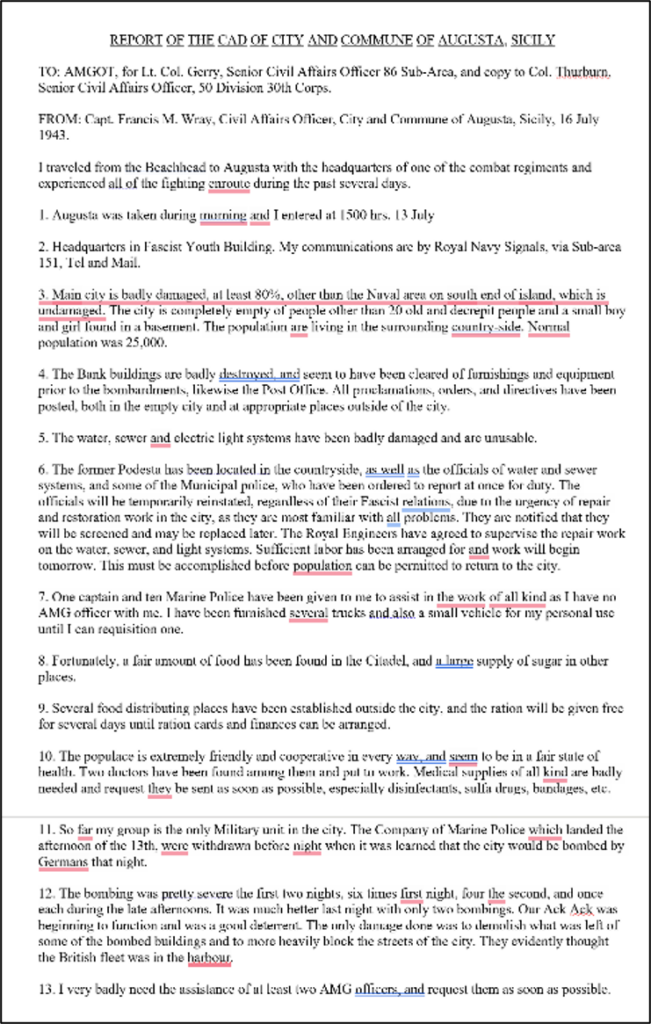
[An example of what a lone CA officer encountered as he entered a Sicilian town with the combat element. This report illustrates the conditions under which Captain Wray and his ad hoc group worked while the town was still under fire, the varied problems they faced, and some of their solutions. (Case Studies, pp 232-233.)]
AMGOT relied on a well-coordinated network of volunteers from the American and British Red Cross to deliver humanitarian relief throughout the occupied area. Fascist political leaders were retained in place to help run the government and organize the population until they could be vetted and, if necessary, replaced. Over time, as combat operations in Sicily subsided, AMGOT relied on military resources, including medical, engineering, and logistics units, until it established capabilities and resources in those areas within the host nation population.
This template was refined and used with great success during the Italian Campaign from September 1943 to May 1945, from the Normandy landings in 1944 through the fall of Berlin in 1945, and beyond into the postwar period. However, while military government was established in Germany by several Allied forces, transitional governance in liberated territories, such as France, Belgium, and the Netherlands, took the form of civil affairs support to legitimate sovereign governments as they worked to regain control of governance functions following the collapse of the former Nazi occupation governments.
(The last 3 paragraphs are drawn from SBG, Chapters IX, X, and XIV.)
Naples:
Not everything went perfectly, however. In On to Berlin: Battles of an Airborne Commander 1943-1946 (OTB), Lieutenant General (Ret.) James Gavin, the commanding general of the 82nd Airborne Division during WWII, recounts a story that reminds me of what another commanding general of the 82nd Airborne Division told me in Afghanistan in 2010: “We have never done anything like this before.”
On 1 October 1943, then-Colonel (Col.) Gavin commanded the 505th Parachute Infantry Regiment, which had been attacking toward Naples with the British 23rd Mechanized Brigade. There were signs that the Germans had withdrawn from the city that morning and, just before noon, when 23rd Mechanized Brigade reconnaissance confirmed it, Col. Gavin was informed by his Regimental S-3, that “‘we are to wait until a triumphant entry is organized.’ ‘A triumphant entry!’ I exclaimed. ‘How in the world can we organize such a thing? It takes participation of the natives.’ I had never put anything like that together in my life…” (OTB, p. 71; bold font and italics added for emphasis.)
It appears that, at this early point in the war, these BCT-equivalents did not have ready access to civil affairs teams to conduct civil engagement with “the natives” and to coordinate their peaceful entry into the city. Just as important, it appears that division and higher headquarters lacked the CA capacity or capability to research the area’s history and advise commanders on potential civilian responses to branches and sequels of military operations. This lack of awareness led to an embarrassing situation.
“Word came down that General Clark was going to come to the head of the column and that he would lead the triumphant march into the city. Then word arrived that we were to lead them into Garibaldi Square. I found it on the map; it was in front of the railroad station…
It was midafternoon before we were fully organized and Generals Clark and Ridgway took their place in the column. Finding my way in was not so difficult as I had anticipated, and the streets were ominously empty. The map took us right to Garibaldi Square, and as we pulled up into it, there was hardly a soul in sight. As General Clark described it in his book, Calculated Risk, ‘There was little that was triumphant about our journey. …I became aware that there was something besides the wreckage that impressed me. I felt that I was riding through ghostly streets in a city of ghosts. We didn’t see a soul. …I made a quick survey of the area around Place Garibaldi and still saw almost no Italians, but I was becoming conscious of the eyes that peeked out on us from behind the closed shutters of every house and every building. It was still that way as we drove out of Naples.’
Later I learned that thousands of people had massed at the Plaza Plebiscito about a mile away in another part of the city. It was here that the conquerors traditionally had been received, and the people had assumed that that was where the Allied generals would make their triumphant appearance” (OTB, pp. 72-73; bold font added for emphasis).
[NOTE from the CATR Team Chief: The following vignette is drawn from “CASE STUDIES ON FIELD OPERATIONS OF MILITARY GOVERNMENT UNITS, TRAINING PACKET NO. 7 FOR [ORGANIZED RESERVE CORPS] ORC UNITS,” published on 1 April 1950 by The Provost Marshal General’s School at Fort McPherson, GA, (Case Studies). In the vignette, we use current doctrinal terms to describe activities that align with CA’s core competencies and missions.]
France.
By June 1944, the SMG, CATS, and CA Center in Shrivenham, England, had produced several hundred, if not thousands, of CA and MG Soldiers for service in the European Theater of Operations (ETO). Forward-positioned in England, these Soldiers were organized into dozens of CA and MG detachments assigned at the corps and division levels. An AI-assisted analysis, which considered contemporary doctrinal references and the WWII CA/MG employment model, estimates that as many as 150 U.S. CA and MG personnel supported the Army headquarters, two corps headquarters, and three of the five divisions that constituted the U.S. D-Day assault forces in Normandy, once the beaches were secure. (No CA or MG detachments were assigned to airborne units on D-Day.) From then on, CA and MG attachments maneuvered in direct support of combat forces or executed general support governance operations, according to mission priorities on the fluid battlefield.
Cherbourg:
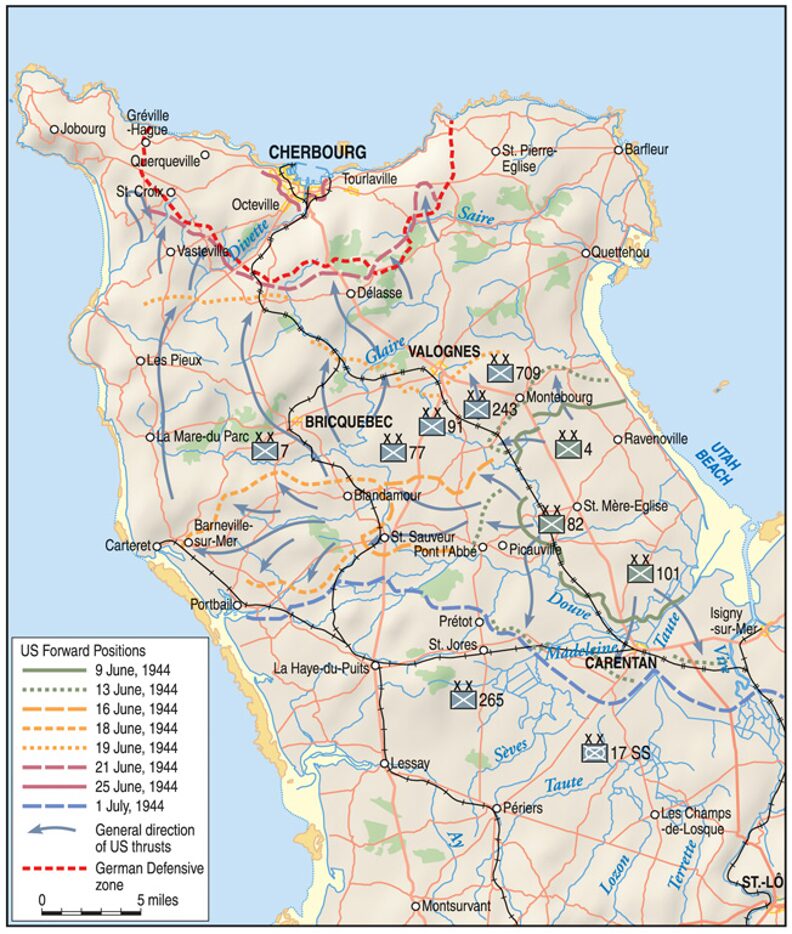
The port city of Cherbourg, located on the Cotentin peninsula in the northwesternmost part of Normandy, was a major objective following the D-Day landings on 6 June 1944. Its pre-war population of 38,000 was reduced to 5,000 by the time it was liberated on 27 June 1944. The city lay in ruins after Allied air and naval bombardment of the port facilities and an intense ground battle that culminated in its liberation. Its deep-water port was essential to sustaining Allied operations in Europe and eventually became the world’s busiest port, with massive amounts of troops, equipment, and supplies passing through the city as the Allies drove east toward Germany. Cherbourg facilitated key logistics operations, including the Red Ball Express.
On the evening of 14 June (D+8), 22 members of a multi-national Civil Affairs Detachment A1A1 (3 U.S. and 5 British officers, 2 U.S. warrant officers, 1 U.S. Navy officer, 1 French liaison officer, and 10 U.S. enlisted men) landed at Utah Beach. (The remaining 10 officers and 12 enlisted men of the detachment would link up on 28 June.) The detachment’s mission was to “organize civilians to prevent interference and contribute to the military mission.” It was assigned to VII Corps headquarters until the morning of 22 June, when it was attached to the 9th Infantry Division (ID). As the 9th ID fought to capture the city, the detachment conducted civil reconnaissance and civil engagement to collect as much information as possible about the civil security situation in Cherbourg. This included population numbers, administrative organization, leadership personalities, and the status of food and economic activity. By 27 June, when it entered the city “on the heels of the combat troops, [and] set up [its] headquarters in the Chamber of Commerce,” the detachment had “a very fair idea” of conditions in the civil component of the operational environment (OE) (Case Studies, pp. 40-41; bold font added for emphasis).
[Source: https://warfarehistorynetwork.com/article/d-day12-assault-on-cherbourg/]
As allies, French municipal and regional authorities were responsible for civil administration, while Allied forces handled military operations. For the next 60 days, the detachment supported French civil administration by “act[ing] as a buffer between civilians and the [A]rmy ensuring that the former had a fair deal and also that the [A]rmy secured whatever was essential for the military effort” (Case Studies, p. 54). Major friction points centered on military requisitioning and the tension between priority needs and civilian rights, political uncertainty over the recognition of French authorities, restrictions on movement and services, and social disorder caused by looting and population displacement. These tensions were exacerbated by frequent changes in military command and the heavy Allied presence.
The detachment comprised twelve special staff sections covering supply, civil defense, public safety, public health, public utilities, public works, finance, legal, relief, economics and labor, communications, and transportation, and carried out both advisory and operational tasks. Rather than imposing solutions, the detachment used negotiation, formal orders, and joint teams to preserve French pride and legal processes while meeting military needs. The combination of legal advice, negotiated settlements, and practical controls resolved most conflicts and left local officials satisfied when the detachment later handed over responsibilities to them.
Key actions included helping to reconstitute the Cherbourg city government and public services, restoring water and rail services, reopening courts and legal tribunals, turning over Pasteur Hospital to French civil authorities, reestablishing postal, radio, and banking services, organizing billeting for military forces, establishing civilian travel permits, cataloging and distributing captured food and materiel, and coordinating vehicle and transportation controls for military and civilian needs. The detachment commander represented the VII Corps commander in civil engagements and ceremonies with HN authorities, allowing the corps commander to focus on planning follow-on combat operations.
By mid-August, CA Detachment A1A1 conducted a phased handover of full civil administration to French authorities. It transferred authority, canton‑by‑canton (Beaumont‑Hague, Octeville, St.‑Pierre‑Église), to smaller, local CA detachments, with two A1A1 representatives to ensure continuity, then closed those field offices once the conditions for stabilization of civil functions were met – generally within two weeks.
This “first large Civil Affairs operation” (Case Studies, p. 40) on the continent tested training and refined procedures under combat and occupation conditions. Detachment A1A1’s successful performance in its duties did not go unnoticed. It later served as the nucleus of CA operations in Paris and, after Germany’s fall, as the nucleus of governance of the American sector in Berlin.
Questions for our teammates: Were you aware of the history of CA units’ involvement in offensive operations during LSCO? Do these vignettes provide better context for how we might integrate CA capabilities in future LSCO?
Send a note to the Civil Affairs Team Room.
Subscribe for updates to the Civil Affairs Team Room Blog
Don’t forget to check out our affiliated sites
Quiet Signal (formerly LC38 Brand) – Use code CATR2026 at checkout
Aerial Resupply Coffee – Use code CATR2026 at checkout
One response to “CATR Post #32 – What is the role of Civil Affairs in large-scale combat operations? (Part 5 – CA and MG in offensive operations.)”
[…] CATR #32, I stated that the mission of the multinational Civil Affairs Detachment that entered Cherbourg, […]