
8-minute read
Looking past North Africa.
We noted in CATR #29 that President Roosevelt initially intended that civilian, not military, officials manage civil affairs in liberated and occupied countries in Africa, Europe, and the Pacific. As the Center for Military History put it:
“Believing that these essentially political tasks called for civilian rather than military aptitudes, the President and his advisers planned initially to entrust the conduct of civil affairs to civilian rather than military agencies as soon as military conditions permitted. But the plan was not carried out, and as matters developed the Army had on its hands for the duration a twofold task which required the soldier to serve military expediency on the one hand and politico-social directives on the other.
…
the President’s eventual decision to entrust the responsibility in the initial phase to the Army was due to civilian unreadiness [for operations in North Africa] rather than to any inveterate Army ambition” (SBG pp VIII-IX).
In CATR #30, we learned that the War Department also recognized that the attempt to use U.S. and UK civilian organizations to manage civil affairs in North Africa was a debacle. Since “every civil affairs problem is bound up with military operations” (SBG, p. 31), future civil affairs and military government operations would have to be conducted by uniformed Soldiers. In this excerpt from a letter to the Secretary of the Interior, Honorable Harold LeClair Ickes, historian, political scientist, and advisor to the Army on occupation planning, Mr. Saul K. Padover wrote on 8 January 1943:
“The civilians are in danger of losing the postwar world by default. They are in danger of losing out because they seem to lack a comprehensive plan and a unified purpose. The Army, on the other hand, has a plan and a purpose. The Army’s plan is to train administrators for the postwar world and thereby to control it. Furthermore, this plan will monopolize all of the training and research facilities of the country by a process of total absorption. In other words, the present plan is to put the men skilled in social science, public law, administration, scientific management, etc., into uniform” (SBG, p. 26; bold font added for emphasis).
Before we continue with our look at how these men in uniform conducted civil affairs operations in the European and Pacific Theaters of Operation (ETO and PTO), we need to understand what the War Department did to address the challenge of training enough personnel for the task and to resolve the friction, delay, and confusion caused by placing civil affairs under civilian control during the North African campaign.
Expanding the Civil Affairs/Military Government (CA/MG) training base.
In CATR #29, we learned that the Army’s Provost Marshal General (PMG) established the School of Military Government at the University of Virginia in Charlottesville, VA, in May 1942, just six months before Operation Torch began. The school trained officers in military government for North Africa and Europe and produced the first waves of CA/MG staff officers for Operation Torch and the subsequent campaign in Italy. But as the war expanded – especially into the Pacific – the Army needed far more personnel and region-specific preparation.
Brigadier General Cornelius W. Wickersham, Army of the United States, was the first Commandant of the School of Military Government. As early as June 1942, he recognized that the school, by itself, was inadequate to meet the number of Soldiers required to conduct military government in the projected occupied enemy territory or, temporarily, in “the occupation of the territories of neutrals, quasi-neutrals, puppets, or even allies” (SBG, p. 12). He noted that “The American occupation of the Rhineland during the last war involved at no time an excess of 250,000 American troops. The number of military Civil Affairs personnel required there was 213, or approximately 1/10 of 1 percent of the armed forces” (ibid.). Based on this historical model and the populations of Germany and Japan, he calculated that “The combined total might run to several thousand men capable of functioning under military control and direction, but with consistent political and economic policies in widely separated areas all over the world, and in some instances, under circumstances where there will be little, if any, international precedent” (SBG, p. 13).
He recommended that the school in Charlottesville train only the core leadership of military government forces and increase its class size to 150 students. Subordinate officers and enlisted personnel would be trained through a coordinated effort involving the School of Military Government, the Military Police Schools, the Army Specialist Corps, the Board of Economic Warfare, and approved universities and colleges that would provide instruction in civil affairs in general and selected functional specialties according to individual school programs. Ultimately, his recommendation led to the expansion of CA/MG training beyond Charlottesville to seven additional universities in the United States and one major overseas program at Shrivenham, England. These programs were designed to rapidly produce CA/MG officers for the European, Mediterranean, and Pacific theaters. Graduation numbers varied by institution, but collectively these programs trained over 6,000 officers between 1942 and 1945.
The chart below shows what that looked like.
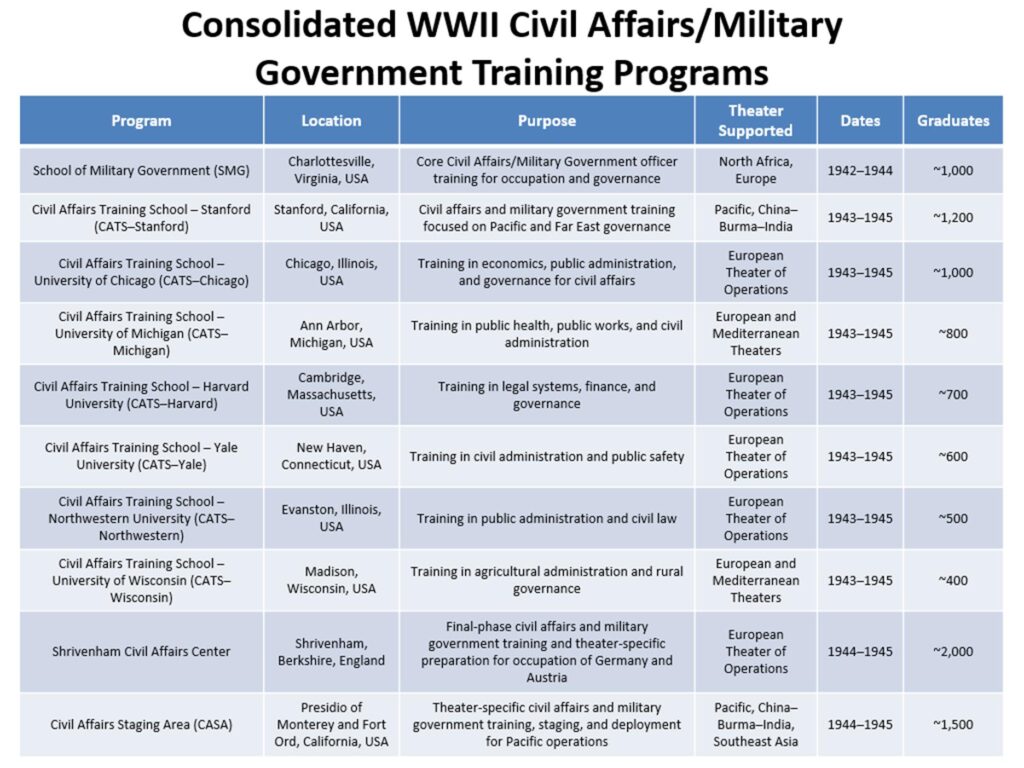
Chart created with the help of Copilot using information found in Civil Affairs: Soldiers Become Governors and other online sources available to it on 22 March 2026.
Establishing the Civil Affairs Division at the War Department.
As important as it was to train a force of Soldiers for a completely new mission while engaged in combat operations, it was equally important to establish a single office within the War Department to develop civil affairs policy, guidance, and operations in coordination with the theater commanders.
The road to establishing that office began in January 1943, when Harold H. Neff, a Special Assistant to the Under Secretary of War, Robert P. Patterson, was tasked with examining the War Department’s organization for civil affairs in North Africa. He found that “the powers concerning Military Government are scattered within the War Department, and delimitations of authority are not clear” (SBG, p. 66). Some agencies designated in the Basic Field Manual for Military Government as responsible for planning, policy development, or operational support performed none of these functions during the operation in North Africa. Meanwhile, other agencies not named in the manual assumed responsibilities as they responded to questions from their counterparts in theater about planning, policy, and operational support. Neff suggested that the Under Secretary consider “the charging of some single unit in the War Department with all of the powers and duties concerning military government” (SBG, p. 67).
In early February 1943, high-level meetings and private discussions among general officers and senior civilian leaders addressed the issue, including several between the Chief of Staff of the Army, General George C. Marshall, and the Secretary of War, Henry L. Stimson. On 1 March 1943, four months after the start of the North African campaign, the War Department established the Civil Affairs Division (CAD). Its initial role and its relationship to the Secretary of War, the theater commanders, and U.S. government civilian agencies are best outlined in this excerpt from a War Department message to the theater commanders on 6 March 1943:
“…In response to a need in the War Department for a centralized organization for co-ordinating matters pertaining to civil affairs which arise in the North African theater and which will also be present in any territory captured from the enemy there is being established in the War Department reporting directly to the Secretary of War a Division of Civil Affairs. This Division will provide a central point for funneling such matters to the various operating agencies of the War Department for action and will provide a means for following up and co-ordinating action taken. It will also provide a means for liaison and co-operative action with other agencies of the Government and insure that such action is co-ordinated with the military effort. To this Division will be routed communications on strictly civil affairs matters as differentiated from those where the interest is solely military and arrangements will be made for it to receive copies of pertinent communications received or dispatched through State Department or other channels. All communications on purely civil affairs matters sent by the War Department to theater commanders will be processed by the Division of Civil Affairs through the Operations Division War Department General Staff to insure co-ordination with military operations. It is considered essential that you establish at the appropriate time an agency on your staff headed by a suitably qualified individual and staffed with specialists competent to advise and handle matters pertaining to functions listed below. The War Department stands ready to assist in procuring necessary specialists on request…”(SBG, p. 69).
Acting Director Colonel John Henry Farrell Haskell led the CAD from 1 March 1943 to 7 April 1943. He likely spent this month establishing the new division’s structure, procedures, and workflow, building relationships, and carrying out the functions outlined above.
Major General John H. Hilldring was appointed Chief of the CAD on 7 April 1943. The division was placed on the General Staff, where it came under both the Chief of Staff and the Secretary of War. About a month after its creation, the CAD was shifted to the Special Staff, where it remained for the duration of the war.
Questions for our teammates: Do you see any lessons from the expansion of the CA/MG training base or the establishment of the CAD at the War Department that you would like to share?
Send a note to the Civil Affairs Team Room.
Subscribe for updates to the Civil Affairs Team Room Blog
Don’t forget to check out our affiliated sites
Quiet Signal (formerly LC38 Brand) – Use code CATR2026 at checkout
Aerial Resupply Coffee – Use code CATR2026 at checkout
One response to “CATR Post #31 – What is the role of Civil Affairs in large-scale combat operations? (Part 4 – Fixing the Civil Affairs problems of North Africa.)”
[…] occurred during the U.S.-British invasion of Sicily in July 1943. By then, as shown in the chart in CATR #31, the School of Military Government (SMG) at the University of Virginia had existed for just over a […]