
9-minute read; Researched and edited with AI assistance.
Introductory Note from the CATR Team Leader: This is the last of five lessons, or takeaways, from our look at CA in large-scale combat operations (LSCO) using examples from WWII that began with CATR #28.
COL(R) DJC
________
Takeaway #5: Command emphasis and freedom of action were critical to the effectiveness of CA and MG organizations.
Several years ago, I attended a formal Civil Affairs Association dinner where the guest speaker, a four-star commander of a sub-theater of operations, admitted he was “deficient in civil affairs for the first 20 years of [his] career.” His first real contact with CA Soldiers and operations came as an infantry brigade commander in Bosnia and Kosovo in 2001. He said he appreciated the knowledge and expertise of the USAR CA staff officers and teams attached to his unit. They were resourceful and helped him succeed in his mission by maintaining strong networks and achieving results within the civilian community – capabilities developed over the years since operations began there.
A vignette from 1990s operations in the Balkans:
During Operation Joint Endeavor in Bosnia (1995-1996), senior commanders recognized that lasting stability required more than separating former combatants. They empowered CA Soldiers to work directly with local leaders and institutions while supporting the 1st Armored Division’s Task Force Eagle. During the initial force buildup around Tuzla, CA teams from the 96th Civil Affairs Battalion (Airborne) coordinated directly with local officials and property owners to resolve disputes, secure facilities, and rapidly establish operational bases, enabling the arrival and employment of Task Force Eagle forces. Deployed USAR CA teams contributed specialized civilian expertise across numerous functional areas and, as the mission transitioned from implementation to stabilization, supported civil administration and broader reconstruction efforts throughout Bosnia. This command emphasis and decentralized approach enabled CA forces to solve local problems quickly, remove obstacles to military operations, and advance broader stability objectives. This pattern continued in subsequent stabilization and peace-support operations in Bosnia and Herzegovina and later in Kosovo, where military forces worked alongside international organizations and local institutions to support security, governance, humanitarian assistance, and reconstruction.
(Sources: Articles “Managing Civil Affairs in Bosnia” (Lane), “How Effective Was Civil Affairs in Bosnia?” (Lescher), CSIS Study “Civil Affairs in Bosnia,” CMH Pub 70-97-1, “Bosnia-Herzegovina: The U.S. Army’s Role in Peace Enforcement Operations, 1995-2004,” and NATO Report “NATO’s role in Kosovo.”
The lessons of WWII were relearned early in the operation. Civil affairs formations need sufficient authority, flexibility, and latitude to act without seeking approval for every decision. Early-deploying CA units earned commanders’ trust by rapidly resolving basing, access, and civilian coordination issues that directly affected force deployment and operations. Their ability to engage local officials, landowners, and institutions provided commanders with unique access, information, and practical solutions, leading many leaders to view CA personnel as indispensable partners in mission execution.
My earliest CA experience of command emphasis and freedom of action: negative to positive.
Looking back on my first CA deployment to Operation Restore Hope in Somalia, my CA team and a sister CA team were operationally ineffective for ten days after our supported unit’s reassignment to Mogadishu. We had just spent 30 days in Baidoa, where we had developed a strong understanding of the civil environment by interacting with local leaders and NGO representatives, while the regimental combat team (RCT) commander led his Marines in executing the security tasks required by the mission.
We were prepared to do the same in Mogadishu, but in this new environment, the RCT commander took on new roles, including participating in mostly ceremonial meetings with local citizen groups. The colonel we worked for assigned us to provide security for him and the commander during their highly public engagements. Meanwhile, the Joint Task Force (JTF) Somalia commander’s critical information requirements (CCIRs), such as determining the ideological differences and physical boundaries between the clans in the capital and locating suspected pockets of supporters of the rival faction leaders on either side of the “Green Line,” were not being addressed.
To my team’s relief, I convinced the colonel to reassign us to a subordinate battalion commander whose daily briefings showed he was doing more constructive work with district leaders across the city. He needed help connecting certain citizen groups with the international relief community to make his unit’s patrol sectors more secure. After a few days of shadowing the commander, my team was given the freedom to respond to subordinate units’ requests for assistance as we established relationships with community leaders in those units’ patrol sectors. As the only CA team operating in the entire capital, we soon found answers to JTF CCIRs through these engagements.
The lesson was clear: commanders do not maximize the value of CA formations by closely controlling them or assigning ancillary tasks. They maximize CA effectiveness by setting clear priorities aligned with operational objectives, trusting the CA Soldiers assigned to them, and granting CA teams the freedom to engage the civil environment, build relationships, and solve problems within the commander’s intent. Command emphasis of CA operations signals to the force that engaging the civil environment matters; freedom of action enables CA Soldiers to deliver the results that justify that emphasis.
My last CA experience of command emphasis and freedom of action: not too good.
Years later in Afghanistan, I saw the same principle from the opposite perspective: not trust and freedom, but tight reins and underutilization of CA capabilities because of a limited understanding of their contribution to the mission.
During Operation Enduring Freedom Rotation 10 (OEF X), U.S. Air Force lieutenant colonels and U.S. Navy commanders who served as Provincial Reconstruction Team (PRT) commanders in RC-E assigned their CA teams primarily to deliver humanitarian assistance supplies or manage projects funded by the Commander’s Emergency Response Program (CERP). They rarely, if ever, used their CA teams to develop or seek answers to CCIRs that would help them or the commanders of coalition forces from nearby brigades, through the International Security Assistance Force (ISAF) headquarters, understand the political, economic, social, and other aspects of the population to support the counterinsurgency effort.
Some people would say that’s a role for the intelligence community. This is how the senior ISAF intelligence officer and two of his staff officers opened a paper published by the Center for a New American Security in January 2010:
“Eight years into the war in Afghanistan, the U.S. intelligence community is only marginally relevant to the overall strategy. Having focused the overwhelming majority of its collection efforts and analytical brainpower on insurgent groups, the vast intelligence apparatus is unable to answer fundamental questions about the environment in which U.S. and allied forces operate and the people they seek to persuade. Ignorant of local economics and landowners, hazy about who the powerbrokers are and how they might be influenced, incurious about the correlations between various development projects and the levels of cooperation among villagers, and disengaged from people in the best position to find answers – whether aid workers or Afghan soldiers – U.S. intelligence officers and analysts can do little but shrug in response to high level decision-makers seeking the knowledge, analysis, and information they need to wage a successful counterinsurgency.” (Bold font added for emphasis.)
Today, we know that civil preparation of the battlefield (CPB) is a doctrinal CA activity that feeds the intelligence process. However, at the time, terms such as CPB, civil reconnaissance (CR), civil engagement (CE), and civil network development (CND) were not part of our doctrine. CA Soldiers struggled to articulate and convince commanders unfamiliar with CA of their value to the fight. Because most PRT commanders and Combined Joint Task Force (CJTF) staff in OEF X had never worked with CA forces before and did not fully appreciate how CA could contribute to operational understanding and decision-making, RC-E CA capabilities remained underutilized.
Toward the latter part of my tour, as Director of the RC-E Stability Operations Information Cell, I tried to get the CJTF J3 (a promotable lieutenant colonel who had just left battalion command to take the position) to publish a fragmentary order (FRAGO) that included the tasks on the slide reproduced below. I was told, “Sir, we don’t tell commanders how to suck eggs. We give them the resources and let them figure out how to use them.” The FRAGO was never published. CJTF headquarters returned to the States two months later, and PRT commanders still did not use organic CA assets to their fullest potential. As a result, many CA teams remained focused on projects and humanitarian assistance activities instead of systematically developing the civil information and relationships that could have informed command decisions and supported the broader counterinsurgency effort.
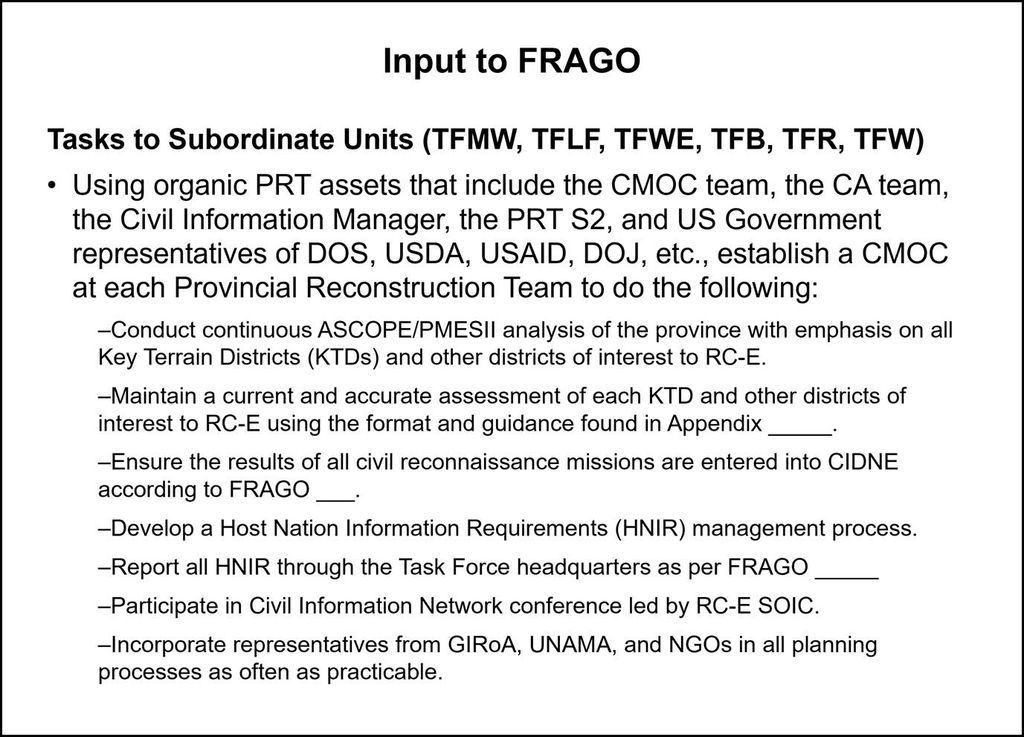
The mission command factor.
Just as CA and Military Government (MG) forces in World War II enabled commanders to concentrate scarce combat power against Axis forces while securing civilian populations and restoring governance, modern CA forces are most effective when integrated early, clearly prioritized, and empowered to operate within the commander’s intent. As shown in the Pacific Theater examples in CATR #35, this commitment must extend from the theater level down to the lowest battalion or company with attached CA units. When employed this way in the next LSCO, CA forces will generate civil understanding, mitigate emerging problems within the civil component, and create conditions that support mission success.
This is fundamentally a mission command issue that we must address in training events and exercises now. I am encouraged to hear from active duty and reserve component CA colleagues that senior leaders seem more interested in the role of CA in LSCO than in the past. Several commanders and staffs at the division level and above are beginning to request more CA forces to participate in their combat training center rotations and warfighter exercises to address the civilian challenges they know they will face. Improvements in technology and policies that support the command and control warfighting function are making it easier for CA units to demonstrate how civil conditions affect military operations and how CA actions remove civil problems from the commander’s plate. Finally, the doctrine division at the CA branch proponent is about to publish a series of graphic training aids and updated doctrinal materials that will help the force close knowledge gaps created by the rapid pace of change since our last major deployments.
In my opinion, all of this will enable CA forces to recover the legacy of our WWII predecessors and Secure the Victory for the next LSCO.
Questions for our teammates: Do you agree or disagree with Takeaway #5 and my interpretation of the lesson? Do you have any observations of CA in LSCO from your experience in named operations, training events, or exercises you’d like to share?
Send a note to the Civil Affairs Team Room.
Subscribe for updates to the Civil Affairs Team Room Blog
Don’t forget to check out our affiliated sites
Quiet Signal (formerly LC38 Brand) – Use code CATR2026 at checkout
Aerial Resupply Coffee – Use code CATR2026 at checkout
Dennis J. Cahill, Sr.
Colonel (Retired) Dennis J. Cahill, Sr., retired from active duty in 2011 after serving 27 years in the U.S. Army, 19 of which as a Civil Affairs officer in both the active and reserve components. He enjoys researching, writing, editing, and discussing Civil Affairs topics.