10-minute read
Doctrinal definition of defensive operations.
According to Army Field Manual (FM) 3-0, Operations,
“A defensive operation is an operation to defeat an enemy attack, gain time, and develop conditions favorable for offensive or stability operations (ADP 3-0)…Defensive operations preserve control over land, resources, and populations, and they protect lines of communications and critical capabilities against attack” (FM 3-0, p. 10, para 1-46; bold font added for emphasis.)
According to FM 3-57, Civil Affairs Operations,
“The full capability of the CA force is essential to and manifests in the conduct of successful defensive operations at the strategic, operational, and tactical levels. [Civil affairs operations] CAO support to defense includes the execution of all four CA core competencies and continuous analysis of the civil component – in terms of both operational and mission variables – by CAO staff elements…” (FM 3-57, p. 3-7, para 3-25; bold font added for emphasis).
That paragraph lists about twenty critical tasks performed by CA forces supporting the defense. With the assistance of Copilot AI, I’ve consolidated those into five tasks that capture the actions of the civil affairs and military government (CA/MG) detachments highlighted in this post:
- Develop and maintain a civil understanding to inform the commander.
- Shape and leverage civil networks to maintain order and civil control.
- Protect military freedom of action by managing civilian movement and mitigating interference.
- Secure, protect, and manage critical civil infrastructure.
- Provide civil‑component options and stability actions that shape the defensive fight.
Campaign credit in WWII.
The U.S. Army flag bears 190 campaign streamers that commemorate “particular action[s] or series of actions, involving combat, which [have] historical significance or military importance to the Army and the nation” since the Revolutionary War. In today’s terms, these actions or series of actions involving combat include variations or combinations of offensive, defensive, and stability operations.
The U.S. Army Center of Military History identifies 38 campaigns in which the Army participated during WWII (American Theater – 1; Asiatic-Pacific Theater – 21; European-African-Middle Eastern Theater – 16).


Sources: History of the U.S. Army Flag; Eagle Mountain Flag and Flagpole
The Ardennes–Alsace Campaign, from 16 December 1944 to 25 January 1945, marked the last major German offensive against Allied forces in the west. It comprised six major operations, two of which – the Defense and Withdrawal from St. Vith and the Defense and Siege of Bastogne in the Ardennes – were defensive. We will use these two examples in this post to illustrate how civil affairs supported defensive operations.
Belgium – The Battle of the Bulge.
On 16 December 1944, German forces launched a major offensive from within Germany, striking westward from the densely forested Ardennes along the borders of Germany, Belgium, and Luxembourg. Their objective was to break through the thinly held U.S. VIII Corps sector, seize the key road hubs of St. Vith and Bastogne, and drive rapidly to the Meuse River to split Allied armies and force a negotiated settlement. The initial German attacks achieved surprise and created deep penetrations, but U.S. forces at St. Vith mounted a determined defense that disrupted the German timetable and forced the attackers to commit additional units and fuel. On 21 December, as German armored formations threatened to envelop the position, Allied commanders ordered a withdrawal from St. Vith, ending a five‑day stand that had significantly slowed the German advance. The withdrawal preserved combat power and allowed VIII Corps to reestablish a more defensible line to the west.
Meanwhile, on 20 December, the rapid German thrust encircled Bastogne, but the 101st Airborne Division and attached units held the perimeter despite shortages, isolation, and relentless pressure. Their defense prevented German forces from exploiting the central road network and executing the plan to reach the Meuse. The German offensive gradually lost momentum as fuel shortages, terrain constraints, and stiffening Allied resistance took their toll. On 26 December, elements of the U.S. 4th Armored Division broke through to Bastogne, ending the encirclement and marking a turning point in the battle. Over the following weeks, coordinated Allied counterattacks reduced the salient and restored the front line. The end state was a stabilized Allied position and a German army that had exhausted its remaining strategic reserves, losing the initiative on the Western Front for the remainder of the war.
[With minor edits by me, the previous 2 paragraphs were generated by AI from established, authoritative military history sources on the Battle of the Bulge, primarily the U.S. Army Center of Military History, U.S. Army official WWII histories (Green Books), U.S. Army unit histories, and reputable historical institutions, including the U.S. Army Heritage and Education Center and the National WWII Museum.]

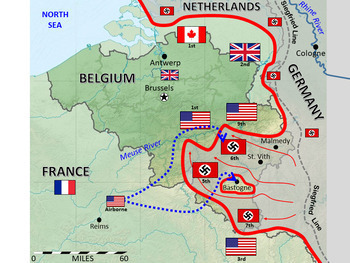
This map shows the disposition of Allied and German forces at the Bulge on/about Christmas 1944.
Source: https://ecdn.teacherspayteachers.com/thumbitem/The-Battle-of-the-Bulge-WWII-Text-Maps-Questions–5076201-1576462387/original-5076201-3.jpg, found by Copilot, 3 May 2026.
Civil Affairs/Military Government support to the defensive operations at St. Vith and Bastogne.
Throughout the Ardennes–Alsace Campaign, CA/MG detachments played an indispensable role in stabilizing the civilian environment, preserving military mobility, and sustaining defensive operations that ultimately broke the German timetable. According to Soldiers Become Governors and the broader historical record of First U.S. Army, Third U.S. Army, Seventh U.S. Army, and XVIII Airborne Corps G‑5 operations found by Copilot in April 2026, between 80 and 100 CA/MG detachments of various sizes operated in the Bulge area of operations from 16 December 1944 to 28 January 1945. This included detachments directly in the path of the German advance; operating in threatened sectors; supporting rear‑area movements, evacuations, and circulation control; and attached to divisions, corps, and army service areas.
Allied forces first entered the Ardennes region (Belgium–Luxembourg) in early September 1944, during the rapid pursuit following the breakout from Normandy. By mid‑September, VIII Corps units (the 4th, 28th, and 9th Infantry Divisions) occupied defensive positions along the Our River and in the Luxembourg Ardennes.
In the days leading up to the unexpected German offensive, the Ardennes area, which includes St. Vith and Bastogne, was considered “quiet” and served as a rest, refit, and holding sector. CA/MG activities included:
- Maintaining civil order in Belgian and Luxembourg towns.
- Coordinating with local officials and police.
- Managing refugees and displaced persons (DPs).
- Monitoring infrastructure (roads, bridges, utilities).
- Supporting VIII Corps with civil-military liaison.
- Preparing winterization measures for civilian populations.
- Stockpiling supplies for future operations.
- Using the Ardennes road network as a rear-area corridor for First Army.
St. Vith. When the German attack began on 16 December, the CA/MG detachment assigned to St. Vith immediately shifted to crisis mode. As artillery shells fell on the town and German infantry advanced through the Schnee Eifel, the detachment confined DPs to their centers, cleared civilians from the streets, and worked to prevent panic. These actions were essential to keeping St. Vith’s narrow streets and key intersections open for the rapid deployment of the 7th Armored Division and the withdrawal of shattered elements of the 106th Infantry Division, which were attempting to form a defensive perimeter around the town.
On 17 December, as German pressure intensified, the detachment received orders from the 106th Division’s Senior Military Government Officer to evacuate St. Vith. Its withdrawal – executed under fire and without the ability to save its supplies – was carried out with discipline and clarity. The detachment moved first to Vielsalm, then to La Roche, and finally to Bertrix, continuing to perform essential civil‑military functions even while on the move. It screened refugees, enforced road controls, and coordinated with military police to keep evacuation routes open. These actions directly supported the U.S. Army’s fighting withdrawal from St. Vith, preventing civilian congestion from choking the very roads the 7th Armored Division needed to delay the German advance. In the days that followed, the detachment assumed responsibility for new towns in the VIII Corps rear area, restoring public order, billeting troops, and managing the influx of refugees fleeing the German onslaught. Its work helped stabilize the corps’ rear area just as the front was collapsing.
Bastogne. While the St. Vith detachment was supporting the northern defensive node, the MG detachments assigned to Bastogne – including Detachments 18G2, H5D2, and 12D2 – were preparing for a very different mission. As the 101st Airborne Division raced toward Bastogne on 18-19 December, these detachments worked with the Burgermeister, local police, and Belgian civil authorities to prepare the town for a possible siege. When German forces completed the encirclement on 20 December, the detachments assumed emergency governance roles. They organized shelter for civilians, coordinated medical care for the wounded, and managed rationing amid severe shortages. Their efforts prevented panic and maintained civil order in a town under constant artillery bombardment.
Within the encircled perimeter, the CA/MG detachments also played a crucial role in maintaining the internal road network. Bastogne’s narrow streets were essential for artillery movement, ammunition distribution, and the movement of reserves. By directing civilians away from key intersections and coordinating with military police to regulate internal traffic, the detachments ensured defenders could maneuver effectively despite the siege. Their work helped preserve the defensive perimeter’s internal lines, allowing the 101st Airborne to respond to German attacks on multiple axes.
After the siege was broken on 26 December, the CA/MG detachments immediately transitioned to recovery operations. They coordinated debris clearance, restored utilities, assisted with burial details, and managed the return of DPs. Their efforts enabled Bastogne to resume functioning as a logistics and command hub, supporting the Allied counteroffensive that ultimately pushed the Germans back to their start lines.
What CA/MG actions meant to the defense.
The CA/MG efforts at St. Vith and Bastogne were closely intertwined. The disciplined evacuation and road‑control measures carried out by the St. Vith detachment helped ensure that the 101st Airborne Division reached Bastogne in time to establish its defensive perimeter. The delay imposed on the German timetable by the defense of St. Vith – supported by the CA/MG detachment’s management of civilians and road networks – was a key factor in holding Bastogne. Conversely, the CA/MG detachments inside Bastogne ensured that the town remained stable, orderly, and functional throughout the siege, preventing internal collapse and enabling the defenders to hold the road hub the Germans desperately needed.
Circling back to the five tasks for CA forces supporting the defense, distilled from current doctrine earlier in this post, we see the following examples in the Ardennes:
1. Develop and maintain civil understanding to inform the commander.
- The St. Vith detachment tracked DPs, local authorities, and infrastructure status during the front’s collapse.
- The Bastogne detachments provided continuous civil assessments to the 101st Airborne Division during the encirclement.
2. Shape and leverage civil networks to maintain order and civil control.
- The St. Vith detachment worked with Belgian police, relief agencies, and local officials to maintain order during the bombardment and evacuation.
- The Bastogne detachments coordinated with the Burgermeister, police, medical networks, and relief organizations to maintain governance under siege.
3. Protect military freedom of action by managing civilian movement and mitigating interference.
- The St. Vith detachment cleared streets, managed refugees, and kept evacuation routes open for the 7th Armored Division and 106th Infantry Division.
- The Bastogne detachments controlled internal movement so that artillery, ambulances, and supply routes could operate inside the perimeter.
4. Secure, protect, and manage critical civil infrastructure.
- The St. Vith detachment managed utilities, food depots, DP centers, and public safety until it was ordered to evacuate.
- The Bastogne detachments helped maintain shelters, medical facilities, and essential services despite bombardment and shortages.
5. Provide civil‑component options and stability actions that shape the defensive fight.
- The St. Vith detachment stabilized successive rear areas (Vielsalm → La Roche → Bertrix) while VIII Corps repositioned.
- The Bastogne detachments sustained civilian morale and order, preventing internal collapse during the siege – a decisive factor in the town’s defense.
In sum, the CA/MG detachments operating at St. Vith and Bastogne formed the civil‑military backbone of the Allied defensive system during the Ardennes Offensive. The CA/MG detachment at St. Vith, along with Detachments 18G2, H5D2, and 12D2 in the Bastogne sector, ensured that civilian populations did not compromise military operations, essential services continued under extreme conditions, and the U.S. Army could maneuver effectively against a massive German assault. Their contributions were indispensable to the successful defense of both nodes and, ultimately, to the failure of the German offensive.
(Case Studies: St. Vith, pp. 59-67, and The Bulge, pp. 122-179, with AI assistance)
Questions for our teammates: Were you aware of the history of CA units’ involvement in defensive operations during LSCO? Do these vignettes provide better context for how we might integrate CA capabilities in future LSCO?
Send a note to the Civil Affairs Team Room.
Subscribe for updates to the Civil Affairs Team Room Blog
Don’t forget to check out our affiliated sites
Quiet Signal (formerly LC38 Brand) – Use code CATR2026 at checkout
Aerial Resupply Coffee – Use code CATR2026 at checkout