12-minute read
With contributions by LTC (Ret.) Albert Augustine and LTC Colin Blair.
The question and the initial discussion.
Back in mid-December 2025, on LinkedIn, the Civil Affairs Association (CAA) posted the following questions: What is the role of civil affairs in irregular warfare? Should this be next year’s issue papers theme? By the time I saw the post, several folks had already responded. The first respondent was Mr. Paul Kruchoski, a former Senior U.S. Diplomat who shared a copy of the slide below and warned those who work in diplomacy, development, or security cooperation that “DOD just redefined your operating environment.”
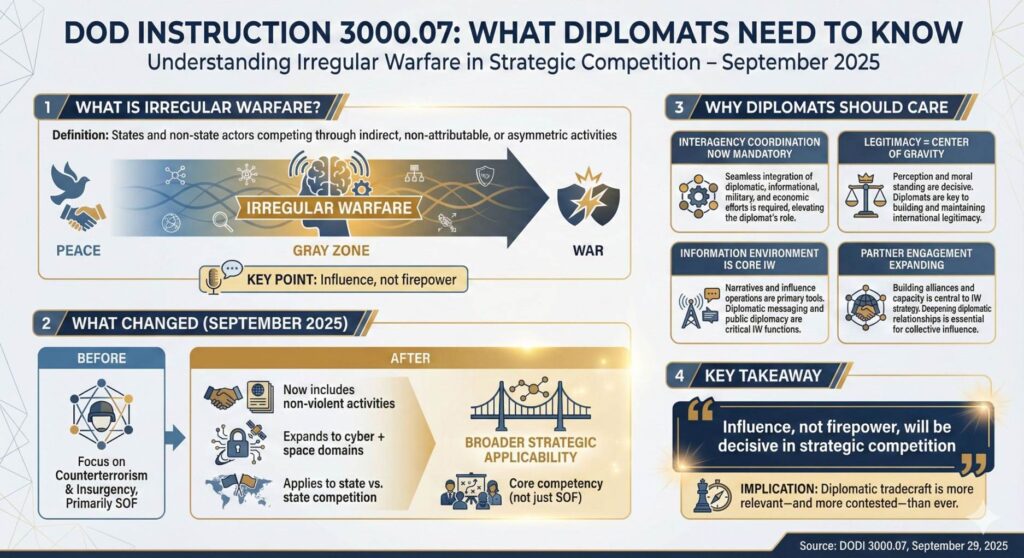
Using my AI assistant to help summarize his comments, he essentially said:
The Department of War’s new Irregular Warfare instruction (DODI 3000.07) redefines the U.S. approach to great power competition by institutionalizing a response to “gray zone” methods – such as proxy support, disinformation, economic pressure, cyber operations, and influence campaigns – used by our adversaries. This policy mandates closer interagency coordination for diplomats, shifting the strategic focus from conventional firepower to a contest of influence centered on eroding the legitimacy of our adversaries and strengthening the political will of our partners. Ultimately, the instruction signals that influence is now the decisive factor in international security, making diplomatic tradecraft more vital and more intertwined with military operations than ever before. [Italics and underline are my own, for emphasis…DJC]
A conversation ensued between two individuals, with about three or four others weighing in at the end. The discussion centered on the belief that conventional forces (CF) should prepare for large-scale combat operations (LSCO), while special operations forces (SOF) conduct irregular warfare (IW). Following that premise, the U.S. Army Reserve (USAR) CA units of the U.S. Army Civil Affairs and Psychological Operations Command (Airborne) (USACAPOC(A)) must prepare for LSCO to support their assigned conventional forces. The SOF CA forces of the U.S. Army Special Operations Command’s (USASOC’s) 95th CA Brigade (SO)(A) are better suited for IW and are not really capable of supporting divisions and corps in LSCO.
One of the latter commenters reminded everyone that operations in Afghanistan and Iraq quickly pivoted to counterinsurgency (COIN) and transitional governance. This pivot discarded CA tasks like populace and resources control (PRC) and military government (MG), which will be conducted again in a future LSCO and in the absence of U.S. interagency partners. He suggested that the next CAA call for papers “include LSCO topics, e.g., Military Governance (sic), key indicators to begin transitional governance, [and] treaty requirements for occupation forces. Another good idea for a topic is the place for CA in IW.”
At about that time, Mr. Kruchoski returned to the conversation. He cautioned that: “Figuring out how to marry the CA, IW, and full diplomatic influence spectrum is really *the* game right now. So much interesting work to be done on that problem.”
Starting a side conversation.
I came in somewhere in the middle of this conversation. My post started a new thread within the main discussion. I said:
“Teammates: I recommend we take a look at the following two documents before we count USAR CA forces out of irregular warfare (IW).
In the unclassified Summary of The Irregular Warfare Annex to the National Defense Strategy, published in 2020, there is a graphic on p. 4 that states, “Myth: IW is CT – CT is SOF – SOF is IW. Reality: Conventional forces have, and always will have, a role in IW across a variety of missions, and a range of military activities.” The Central Idea on p. 3 states: “The Department must institutionalize irregular warfare as a core competency for both conventional and special operations forces, sustaining the ability to impose costs and create dilemmas for our adversaries across the full spectrum of competition and conflict.”
This idea is carried over into the DoDI 3000.07, Irregular Warfare, published 29 Sep 2025. In the Glossary, IW is defined as “A form of warfare where states and non-state actors campaign to assure or coerce states or other groups through indirect, nonattributable, or asymmetric activities.” In the Policy paragraph on p. 3, it states, “Within the DoD, IW is a joint force activity conducted by conventional forces and special operations forces (SOF),” and, “(2) DoD IW operations and key enablers can include, but are not limited to: (a) Unconventional warfare. (b) Foreign internal defense. (c) Counterterrorism. (d) Counterinsurgency. (e) Stabilization activities. (f) DoD support to counter-threat finance and counter-transnational organized crime efforts. (g) Military information support operations. (h) Civil affairs operations.”
With the exception, perhaps, of subparagraph (g) (which, incidentally, if you haven’t heard, DoW changed back to Psychological Operations on 2 Dec 2025), there is a CA role in each of the operations and key enablers listed above.
Therefore, since there appears to be confusion about the role of CA in IW even within our own ranks, I vote yes to the question posed by the CAA.”
Reiterating positions.
Albert Augustine, one of the two individuals engaged in the conversation above, and an avid reader of the CATB, then responded to me directly:
“Is the 95th CA brigade enough to focus on the IW problem set?
Does USACAPOC(A) need to focus on IW or LSCO?
Because I would argue that only USACAPOC(A) is supporting the conventional forces focused on LSCO. With limited dollars and time to train reserve forces, it seems prudent for USACAPOC(A) to focus on LSCO.
Because I doubt that the 95th is going to be the answer for CA and LSCO.”
I responded with:
“I would answer NO to your first question and BOTH to your second.
As I mentioned earlier, the DoDI states, “IW is a joint force activity conducted by conventional forces and special operations forces (SOF).” Of course, we must follow the leads of the Army and USSOCOM when it comes to the focus of particular exercises and training events in which CA forces participate. Conventional force (CF) events are generally focused on LSCO, and Army SOF are increasingly participating in those events to generate capabilities for SOF-CF I3 (interdependence, interoperability, and integration) in LSCO.
I can’t say what a joint force IW exercise would look like, or when it may occur, but all participating forces – whether SOF or CF – must be prepared to execute. Unfortunately, there is only one mention of irregular warfare in the current version of FM 3-57: “These [nine reserve component CA brigades and one special operations-capable CA brigade]…(p)lan, direct, and integrate CNDE to conduct stabilization and irregular warfare across the competition continuum in support of – CCDRs. – U.S. Ambassadors. – Other agencies (as directed).” Surprisingly, the term irregular warfare is not mentioned at all in ATP 3-57-80, Army Special Operations Forces Civil Affairs.
I actually see this as a simple problem to solve. As I stated in my response above, there is a CA role in each of the DoD IW operations and key enablers listed in the DoDI (with the possible exception of MISO). All that CA forces need to do is be proficient in the core competencies and missions outlined in FM 3-57 and the 3-57 series of Army Techniques Publications (ATP), then know how to apply them in IW.
If the CAA question about the role of CA in IW is selected as next year’s issue papers theme, my recommendation to those who take up the challenge of submitting papers is to fully understand IW and how both CF and SOF contribute to DoD IW operations and key enablers, then explore how to apply CA competencies and missions to the CF and SOF contributions. Ultimately, I’d like to see these papers inform FM 3-57 and a new ATP on CA in IW.”
Over the next few days, we continued our one-on-one conversation offline, with Albert saying:
“My thought is that USACAPOC(A) should focus on LSCO.
Between limited training and most of their support to the GCC’s [Geographic Combatant Commands], it seems like the best use of assets.
The knowledge needed, relationships to build, and skills to be developed are enough for reserve soldiers.
More importantly, LSCO is an area that needs CA to fill. The 95th is not the unit to do it.
If USACAPOC(A) wants relevancy and wants to help the Army, then being the premier civil-military node for conventional forces is the way to do it.
Big Army isn’t focused on IW. Look at every major exercise around the globe. Almost all of them are focused on conventional forces fighting and developing lethality.
CA misses the mark by focusing on things that big Army has not prioritized.
You may see it differently. However, I am trying to help the CA community.”
I responded:
“I agree that USACAPOC(A) should focus on LSCO, because that is what the force it works with is currently focused on. As you said, big Army isn’t focused on irregular warfare (at least not yet). Conventional forces are rightfully focused on lethality, because that’s what the Commander-in-Chief and the SECWAR want them to focus on.
If you attended the abbreviated CA Symposium in November, you’ll have heard COL Mike Hanneken and COL (ret) Chris Holshek mention I wrote a DRAFT paper on the CA Role in Lethality that I hope to get pushed out to the Transformation and Training Command (T2COM) soon as a reference for exercises and experimentation.
That said, I don’t believe the application of CA core competencies and missions in irregular warfare is that much different from LSCO. I see irregular warfare as a different environment and one that may well reside alongside conventional war as a branch or sequel to combat operations. My message is that the force needs to consider its role in that environment, including how we would transition from one to the other. We may not need to focus on irregular warfare as much as on LSCO, but I believe we should have doctrinal references in place that we pull out every once in a while to remind us that, as professionals, we must be prepared to apply all CA forces against the problem sets for which CA forces exist.”
Albert came back with:
“Yes, the CA skills do overlap between LSCO and IW.
My biggest issue is that when it comes to LSCO, that is a full-time job. Meaning strategic, operational, and tactical leaders need to be solely focused on that mission.
Learning the environment is one aspect. However, it is building relationships that USACAPOC(A) has issues with.
The frequency of people coming and going make building relationships difficult. For example, in Eastern Europe our NATO partners see different faces every 6, 9, or 12 months. That is no way to build trust or understanding.
Then there is building relationships with U.S. forces from EUCOM, USAREUR-AF, V Corps, and the division that supports Eastern Europe.
I understand the realities of using reserve forces. And some of those issues never go away. However, why make things worse by adding IW and focusing on those issues.
Trying to do everything is going to weaken USACAPOC(A)’s position. In some ways they already shot themselves in the foot by not building those relationships and by not meeting U.S. Army commanders’ expectations.
I really am willing to help if I can.”
I replied:
“Albert: I agree with you on the inability of CA individuals to establish and maintain relationships through military operations. In each of my deployments, because they were either short-duration or rotational, I’ve only gone to each place one time. The relationships I established ended when I left. For one reason or another, I was unable to successfully transfer the networks I developed both within the military community and the civilian community to my backfill.
I just responded to LTC Colin Blair on this thread. I look forward to hearing your thoughts on what I wrote to him.”
Correcting a misstatement.
That last comment was in reference to my separate response to LTC Colin Blair, Chief of the Doctrine Development at USAJFKSWCS:
“Dennis: A slight correction on ATP 3-57.80 – Chapter 3’s title is “Irregular Warfare,” although it does discuss UW as well. See Page 15 of the NOV 24 publication for reference. I’d imagine the new DoDI will prompt revision at the 18-month review mark for our doctrinal products here at Proponent. Cheers!”
To that, I replied:
“Colin: I stand corrected. Thank you very much for pointing this out. When I looked back at ATP 3-57.80, I found that there were, in fact, 33 mentions of the term irregular warfare. I don’t know how I missed it the other day, unless I didn’t give the document enough time to fully download before searching for the term, which I almost did this evening.
When I looked it over again tonight, I found the following sentence in paragraph 3-38 on p. 21, which supports what I’ve been saying thus far: “ADP 3-05 identifies stabilization as an irregular warfare mission area that can be employed by either Army SOF or Army CF in both irregular warfare and conventional warfare contexts.” I think, if we look back at the continuum of operations in the two main theaters of WWII and the kinds of activities conventional forces found themselves in during and after the major combat operations of Operations Enduring Freedom and Iraqi Freedom, we can say the same thing about the other irregular warfare missions covered in ATP 3-57.80 Chapter 3 – unconventional warfare (UW), foreign internal defense (FID), counterinsurgency (COIN), and counterterrorism (CT) – as well as the ones not covered – DoW support to counter-threat finance (CTF) and counter-transnational organized crime (CTOC) efforts, military information support operations (MISO), and civil affairs operations (CAO).
For this reason, I say again that USAR CA forces must know how to apply the CA core competencies and CA missions in an environment characterized by irregular warfare as much as they do in the LSCO environment they are training for now. The question is, how do we impart that mindset to CA Soldiers when they do not see the Army “Incorporat(ing) the ability to conduct IW into all Military Service force development and design products, in accordance with strategic guidance, joint concepts, and prioritized CCMD requirements,” or “Conduct(ing) experimentation to validate these concepts and identify military capabilities required to implement them” (paragraph 2.17.i. on p. 18 of DoDI 3000.07)?
These are some of the issues I hope authors would tackle if the question posed by the CAA is selected as next year’s issue papers theme.”
Questions for our teammates: What do you think? Should the CA Corps be split by component against LSCO versus IW, or should the whole Corps be prepared to conduct civil affairs operations across the full spectrum of competition? Whichever position you take, what would that look like? If this topic is selected as next year’s theme at the Civil Affairs Roundtable in April 2026, would you consider submitting to the call for papers?
Send a note to the Civil Affairs Team Room.
Subscribe for updates to the Civil Affairs Team Room Blog
Don’t forget to check out our affiliated sites
Quiet Signal (formerly LC38 Brand) – Use code CATR2026 at checkout
Aerial Resupply Coffee – Use code CATR2026 at checkout