5-minute read
By Sergeant First Class (Ret.) Karl Kumm
Introductory Note from the CATR Team Leader: In CATR #22 and the Eunomia article, “Revisiting Civil Affairs Operations in Operation Restore Hope,” I describe the composition of my civil affairs direct support team (CADST) in 1992-1993. The battalion commander at the time was a special forces (SF) officer with whom I attended the CA course, and who had participated as a member of the 10th Special Forces Group (Airborne) (10th SFG(A)) in Operation Provide Comfort in Northern Iraq in 1991. (Civil affairs forces from both the active and reserve components were also among the many units deployed for that mission.) He came to the 96th believing that SF NCOs were better trained and prepared to conduct civil affairs missions than the conventional force infantry, engineer, and medical NCOs in the organizational structure at the time. He successfully had the unit’s modified table of organization and equipment (MTOE) changed to replace conventional NCO positions with 18-series positions. While I was unsuccessful in obtaining copies of the previous MTOE with the former position, or the first MTOE to contain this change, I did find a version that shows the structure of a CA company of the 96th in effect in FY99, summarized in the table below, with the 18-series positions circled in green.
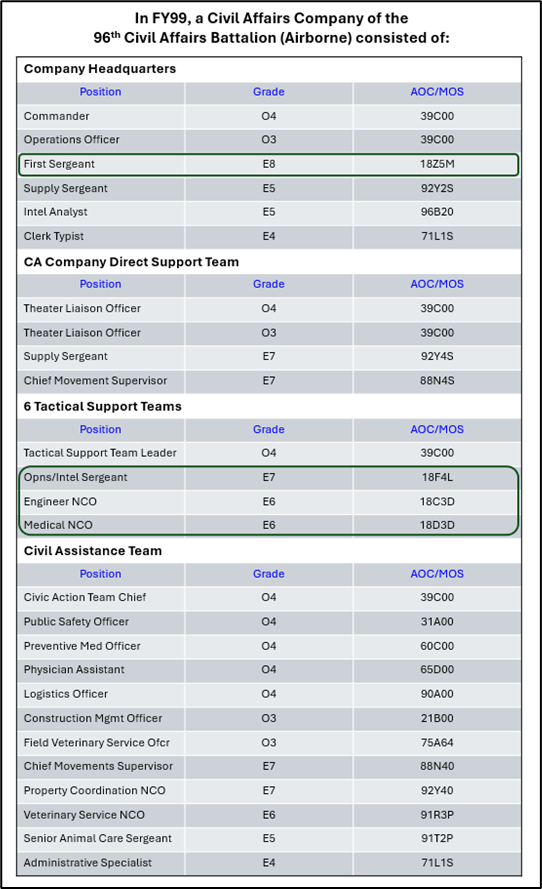
Whatever the first effective date, it appears that SF NCOs began being assigned to the 96th in the first quarter of FY94. SFC (Ret.) Karl Kumm was one of those NCOs.
A faithful reader of CATR, SFC (Ret.) Kumm first responded to CATR 20. His response to the questions at the end of CATR 22 was much longer and deserving of its own separate post.
COL DJC
CATR 22 Questions for our teammates: What was the reception at your first CA unit like? Was it everything you expected, or were there surprises? How different was life in this unit from your previous unit assignments?
22 Jan 2026, SFC (Ret.) Karl Kumm:
Dennis,
I’m not sure you want the enlisted reporting or not, but here it goes.
I reported to A Co, 96th CA Bn (Abn), on or about 6 Oct 1993 as an E7/SFC. I had just spent two years in Panama on an unaccompanied assignment in C Co, 3/7 SFG(A). I don’t remember if we had a team leader at the time or not. My team sergeant was another SFC, an 18F, and our team medic was a 91B SFC. I think the medic had been there for a while. We had to wait a bit for the next 6-week CA course to start, so in the meantime, I went with a few senior enlisted guys (SFC/MSG) to a Joint Staff Planners Course at the Special Operations Academic Facility (SOAF, later called Bank Hall) at Fort Bragg that was officer-heavy. I also got to take the Individual Terrorism Awareness Course (INTAC) at Fort Bragg, required for many deployments to overseas high-threat environments. We did finish the CA course some time before Christmas.
Also worth noting, when we signed in, we got the biggest insult for a Special Forces troop: an issued maroon beret. This was the designated unit headgear at the time. On 1 Nov 1993, a policy change allowed the SF guys to wear the green beret again, but all of the NCO slots were also downgraded. The team sergeant position went from 18Z (a MSG position) to 18F E7, and the medics and engineers went from E7 slots to E6 slots. The hard part was they kept all the E7‘s in those E6 slots. Quite a few were able to talk their way out into the schoolhouse at USAJFKSWCS or somewhere else, but many of us were stuck. It turned out that almost without fail, all E7 engineers and medics with the rated CA time didn’t make MSG, at least while assigned to 96th. There may have been one exception in the 96th during my time, but that guy was, or had been working on battalion staff.
Soon after graduating from the CA course, I was deployed for about 234 days from January through mid-October 1994. This, after coming from my two-year unaccompanied assignment in Panama with Group. For part of this CA deployment, I was back in Panama working with Cuban Refugees at four camps during Operation Safe Haven. I returned to Fort Bragg early for emergency leave, and the rest of my team came back approximately 4 weeks later. We were lucky we left before things got really bad there; one U.S. Soldier was killed and over 200 were injured during the Camp riots in December 1994.
I ended up doing 3 years and almost 10 months in CA. I know that I ruffled a lot of feathers while there, between trying to transfer out or trying to get proper rating schemes, but that’s another story. When I left, I had almost 20 years time in service. I went back to 7th SFG(A) for 2 years and then retired.
Did I enjoy the work? Heck yes! Do I think it was important? Same heck yes! Do I think it hurt my career? Maybe, but there are too many variables to say with 100% confidence.
Questions for our teammates: There are many other stories among the thousands of CA Soldiers and Marines who have served in active and reserve component CA units. Every one is unique and deserves to be shared. We welcome you to write and tell us about the reception at your first CA unit. Was it everything you expected, or were there surprises? How different was life in this unit from your previous unit assignments?
Send a note to the Civil Affairs Team Room.
Subscribe for updates to the Civil Affairs Team Room Blog
Don’t forget to check out our affiliated sites
Quiet Signal (formerly LC38 Brand) – Use code CATR2026 at checkout
Aerial Resupply Coffee – Use code CATR2026 at checkout
Karl Kumm

Sergeant First Class (Ret.) Karl Kumm retired from the U.S. Army in 1999 after 22 years of service. He began his career as an 11C Mortarman, transitioned to 11B Infantryman, then became an 18C Special Forces Combat Engineer. He spent four years in Alpha Company, 96th Civil Affairs Battalion (Airborne), during which time he deployed multiple times to four Latin American countries, including to Panama in support of Operation Safe Haven and El Salvador for Fuertes Caminos. He currently resides in Texas with his family.